Showing posts with label South Africa. Show all posts

14 March 2018

South Africa Trip 2018

My annual trip to South Africa in January and February this year was quite a blessed one. Apart from spending some quality time with family and friends, I also had the opportunity to visit several martial art schools and friends.

In Cape Town, I visited the Instructor Jaren Philips' ITF Taekwon-Do school in Green Point, where I shared some thoughts on Korean body culture and the overlap between Taekkyeon and ITF Taekwon-Do.

With black belts at the Green Point Dojang.
In Kwa-Zulu Natal I visited my friends at the Pinetown Stingers Dojang where we practiced some of break-falling and joint-manipulation techniques.

With some members of the Pinetown Stingers Club. 

In Centurion I presented an ITF principles seminar with participants attending from the greater Pretoria region, Potchefstroom, and the Vaal Triangle. The workshop centered on re-thinking how we apply fundamental motions in a practical manner that makes full use of different possibilities presented to us within the context of the Theory of Power.

WIth some participants at the workshop in Centurion.
I was delighted to be able to visit the Potcheftroom Taekwon-Do school this year. I started this dojang exactly 20 years ago and couldn't have imagined that it would continue to exist for such a long time. The school have always been relatively small, but the quality is consistent and under instructor Philip's care, I am happy say that the Potchefstroom Dojang is doing very well.

With some students at the Potchefstroom Taekwon-Do Club.

Apart from my Taekwon-Do adventures, I also gave an introductory Hapkido seminar in Cape Town. There are hopes that from a small Hapkido training group a Hapkido school will open in the Mother City.

With Anthony Lapperts
I also introduced, for the first time in South Africa, hopaesul -- the study of a Korean weapon known as hopae. The introduction was presented to some higher level black belts as an addendum to the Centurion workshop.

With the Korean weapon, hopae

21 February 2017

Jan & Feb 2017 South Africa Report

I would like to report a little on my journey over the last two months during my annual South Africa travels.


The first dojang I had the privilege of visiting was the Pinetown Stingers club, in KwaZulu Natal. Whenever I visit the Durban area, I also try to visit the Stingers dojang. With my previous visit I wasn't able to visit the dojang, but I did visit with Sabeomnim Sean Cremer at his house. This year, however, my travels coincided with their training, so I could attend one of their session. As always, it was lots of fun training with the KZN guys. My friend Damien, who was a student with me here in Korea and also tested for his black belt under me, was also able to come through from Durban to visit. I've always had a close connection with KZN Taekwon-Do and visiting them is like visiting family.

Of course also visited my Soo Shim Kwan family.


First was my visit with Horangi Dojang in Grobblersdal. This club is just going from strength to strength under the leadership of Instructor Gerhard Louw. I was impressed with how the higher ranking students have improved since I saw them last year -- their are defintely some future champions among them, and the eagerness of the lower belts shows me that Instructor Gerhard is doing a great job.


During the two nights that I taught at the Horangi Dojang, I tried to cover several principles. On the second evening, I was requested to demonstrate some patterns. Last year when I performed patterns there, I was a little sick, so was disappointed with my demonstration. This year, I performed several patterns and felt much more pleased with what I was able to present to them. Bsbnim Gerhard and I also did Gae Baek Tul together, and we also demonstrated some slightly more advanced self-defence techniques, to the glee of the students. For the much of the evening, we practised some self-defence techniques, but more simplified since the Horangi dojang's members are mostly children.

Near the end of my time in South Africa I went to Potchefstroom and visited the other Soo Shim Kwan dojang, the Potchefstroom Taekwon-Do Club (PTC). Under the guidance of Instructor Philip de Vos, there is a good standard amongst the students. The Potch club have always been small in numbers, but what it lacks in quantity, it makes up for in quality. Since PTC is an adults only club, I used the opportunity to explain some important principles. I expounded on the ITF pedagogy as a whole. The club has a few new members, so I wanted to give the students a broader understanding--a theoretical platform--to understand how ITF Taekwon-Do progressively guides a person with no prior fighting experience through a slow process of conditioning (physically and mentally), for a violent, combative encounter. I touched on ideas like the sparring phases, the Golden Move, and how ITF Taekwon-Do attempts to prevent the freeze reflex and trigger a fight response during an adrenalized encounter. The classes had a little bit of a lecture feel to them, which is not a bad thing occasionally since it is associated with a university.


Next year PTC will have its 20 year anniversary. I started the club in 1998. As part of the celebration, PTC will be the host for the National Championships in 2018. I really hope I'd be able to attend the event.

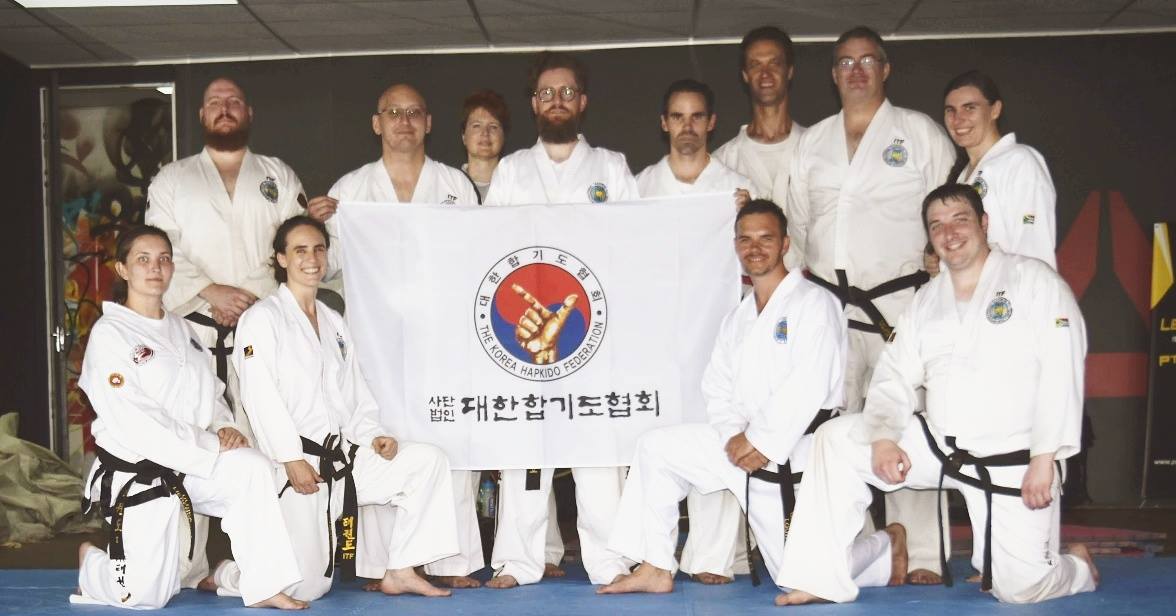
A highlight of this trip was, of course, the Hapkido Seminar that I presented in Pretoria. It was the first Korea Hapkido Federation seminar hosted in South Africa, to a primarily black belt audience.


This seven hours long hands-on workshop covered the most important aspects of Hapkido, from break falls and rolling, to joint locks, throws, pins, and even some unique kicks. The attendees were all tired, bruised and nearly broken, but their eagerness to learn kept them from quitting, and even after such an exhausting event they were still able to muster the smiles you can witness in the photo above. This seminar functioned as the first formal KHF event, with the intention of establishing an offical KHF branch in South Africa. I in particular want to thank Sbnim Sean Cremer and the other KZN members that travelled so far to attend the seminar.

Martial art wise, it was a particularly productive visit for me this year. On my way back from South Africa to Korea, I stopped over in Hong Kong, where I also got to train a little in Wing Chun, which was a wonderful experience that opened my eyes to new ideas and helped me to rethink my understanding of ITF Taekwon-Do as well.

I wish all the Soo Shim Kwan members, and all other readers of this blog, a wonderful 2017. My you experience progress in your martial art path, and also grow in the other areas of your life: vocationally, relationally, mentally and spiritually.

Sincerely,

S

14 February 2016

Jan/Feb 2016 South Africa Trip: Soo Shim Kwan and ATC Workshops

My annual South Africa trip was much shorter than usual – only three weeks, rather than the customary five to six weeks. Nevertheless, I was able to fit in visits at Soo Shim Kwan and ATC dojangs to present some workshops and spend time with my Taekwon-Do family.

I arrived in Johannseburg on Monday, 25 January. The following day I went to Pretoria and visited the Elardus Park, ATC Dojang, run by my good friends, instructors Karel and Annari Wethmar, of our sister federation, the Dan Gun Kwan.


For this first workshop I started with a main theme I had for this visit, namely joint-mobility. As I’m getting older I have a bigger appreciation for the importance of range of motion and joint health. It is common for martial artists to focus on muscular flexibility when they think of increasing range of motion; however, the ease of motion of joints in their sockets is often neglected, yet is of much importance, especially as people get older. Although I tried to cover most joints, my main focus was on shoulder mobility and hip mobility, with emphasis on stretching the psoas muscle.

Explaining the "Golden Move"-principle with the
help of Sabeomnim Manie.

The second part of the evening was more theoretical. First, we discussed certain consideration of the sine wave motion when applied to techniques. Because the Elardus Park dojang has so many black belts, I took the opportunity to touch on a few higher level things. In particular, I aimed to give an overview of the ITF pedagogy, as it may be useful especially for instructors. While the techniques we practised weren’t particularly difficult, I think the concepts were challenging as I questioned the way many ITF practitioners understand some basic movements. My aim was to get the black belts thinking critically about what they are doing.

Finally, we worked on kicks for different angles of attacks, as well footwork for spinning kicks.

My time spent with the ATC folks are always very enjoyable. The students are of great caliber and the instructors are such great friends of mine, we always talk late into the night and always complain that we do not have enough time.

With instructor Gerhard Louw and some students from the
Horangi Dojang, Grobblersdal.

The following day, Wednesday, 27 January, I went to the Soo Shim Kwan school in Groblersdal. Instructor Gerhard Louw’s Horangi Dojang was a priority for me this year. Last year I was not able to go to Groblersdal, so this year I placed it high on my priority list, as I promised Instructor Gerhard that I will visit him the next time I go to South Africa. Spending time at the Horangi Dojang was an absolute treat. The passion of the students and their families is tangible, and the level of some the children are some of the best I’ve seen for Taekwon-Doin youngsters in a long time.

Unfortunately I came down with a bug, and felt terribly under the weather. I had a fever and was lightheaded while presenting the two hour workshop, but I tried to hide my discomfort as best I could, and focussed on teaching as best I could. I really aimed at highlighting specifics that the students could make part of their basic training.

We started again with a focus on mobility work, as well as other stretching and warm up exercises that I thought they may benefit from, to supplement their current warm up routine. Since a number of the new members of the Horangi Dojang are adults in their thirties and fourties, I felt it imperative to emphasize the importance of proper warming up.

We then moved on to kicking drills, and foot work.

Third, I spent some time in teaching break falls and rolls. I focused mainly on the basics for falling and rolling and showed some more advanced techniques that the students could do as they master the basics.

Finally, we did some self-defence training.

At the very end the students requested me to perform some patterns. By this time I was really feeling sick and jet-lag was in full-swing, but I obliged. I chose some of the forms that I thought I knew best; however, I got stuck on both forms. So I asked Instructor Gerhard to join me for a form to help jolt my memory. We did a form—without getting stuck this time—and the students really seemed to enjoy it. I know that my technique was not very good (and pray that nobody uploads the video onto YouTube), but I am happy for the opportunity to have performed a form with my friend at his school.

The following evening the Horangi Dojang planned a special dinner. It was amazing to share some time with them and get a feeling for their great camaraderie and passion for Taekwon-Do. It is definitely a testament to Instructor Gerhard’s character to get his students and their families behind him in such a manner.

As I was still feeling rather awful, the Louw’s nursed me with some medicine, and I must admit that I felt much better by Friday. I should really have taken medicine earlier.

With instructor Philip de Vos and some students from
the Potchefstroom Dojang, North West Province. 
The following week I went to Potchefstroom and got to teach at the Potchefstroom Taekwon-Do Club on both Tuesday and Thursday evenings. Since the Potchefstroom Dojang is my first dojang that I started, I will always have a soft spot for it, and it always feels like coming home when I enter the Potch Dojang.

Over the two nights I covered much of what I had covered at the ATC and Horangi schools the previous week. However, the longer time allowed me to go into a little more detail. I also shared a little more philosophy and focus more on theory. Since the Potchefstroom dojang has fewer members than the Elardus Park and Grobblersdal schools, it was easier to give more individual attention to the students, which was nice.

On the Thursday evening Instructor Philip de Vos and I went out for dinner to catch up and talk about some important topics.

While in Potchefstroom I also met up with Master Louise Villiers of Tang Soo Do, who is the president for Martial Arts South Africa (MASA), which is a branch of SASCOC. It was great to catch up with Master Louise again, and also a very informative and fruitful meeting. Master Louise and I have a long history of cross-training and supporting each other with our respective events.

For the rest of my time in South Africa I focused on seeing family and friends. An important part of my trip was visiting my ailing, 80-year old father. I was able to give my father a formal, printed copy of my PhD dissertation. While my father is too weak and will likely not read it, it was nevertheless nice to give it to him, as he will not be able to attend the graduation ceremony which will occur later this week.

My trip in South Africa, although much shorter than usual, was most definitely a fruitful one.

27 January 2015

Visit to the ATC Pretoria Dojang

Taking students through warm-up drills at ATC Pretoria
I was in Pretoria last week and got to visit Sabeomnims Karel and Annari Wethmar, and Boosabeomnim Chris van der Merwe. On Thursday night I visited ATC Pretoria Dojang where I presented a workshop similar to the one I did at the Soo Shim Kwan Potchefstroom Dojang the week before, focussing on ground work (break falling and rolling), joint mobility and posture, and some thoughts on the Golden Move. I also spent a little time on the sine wave motion and how to ensure it is practised and applied sensibly. Afterwards there was a nice Q&A session.

The Dan Gun Kwan (ATC) and Soo Shim Kwan friendship has come a long way. Not only do we have our promotional tests together, but we also share seminars. Whenever I visit South Africa I'm always invited to ATC to share some of what I have learned during my stay in Korea. I'm always honoured to do so, and very much enjoy their hospitality and the students' eagerness to try new and somewhat unconventional things.

20 January 2015

Visit to the Potchefstroom Dojang


Last week Thursday I visited the Soo Shim Kwan Dojang in Potchefstroom during my visit to South Africa. Since it is still early in the year and many of the university students have not returned from vacation yet, there were only four in attendance. It was nevertheless nice to meet new members of the Soo Shim Kwan family.

During the session with them I covered some ground work (break falls and rolls), and spent some time on (power) posture work in Taekwon-Do and the importance of balanced musculature, pointing out how some muscles are overly stretched and under-streghtened (such as the hamstrings) while the antagonistic muscles are trained too hard, but not stretched enough (quads). Such musculature imbalances can cause injuries in the long run. I also covered some three step-sparring and explained the importance of angle-and-distance / positioning.

I opened the Potchefstroom Dojang in 1998. Seventeen years later it is still active and while not a particularly large school, it is nonetheless still going strong. The numerous medals won during tournaments last year is just one indicator that the current Potchefstroom Dojang instructor, Mr Philip de Vos, is doing a great job. I was pleased to present Bsbnim Philip with a black belt that I had embroidered in Korea just before I departed for South Africa with his name and "III" in honour of his promotion to 3rd degree black belt recently. I also presented the Potchefstroom Dojang with a new set of focus pads, which I'm sure will come into good use.

29 April 2013

Die Kragteorie van Taekwon-Do


This is a translation of ITF Taekwon-Do's Theory of Power into Afrikaans by Retha Fritz from the ITF Encyclopaedia on behalf of the SA-ITF’s Research and Education Directorate.


This translation resorts under a Creative Commons Attribution-NonCommercial 3.0 Unported License. This means that you may freely use and copy it, but not for commercial use, and that you should always include attribution for translation to "Retha Fritz, SA-ITF Research & Education Directorate", with a link to the SA-ITF homepage: www.taekwondo.co.za

Die Kragteorie van Taekwon-Do


Alhoewel oefening ’n uitstekende vlak van fisieke fiksheid tot gevolg sal hê, sal dit nie noodwendig lei tot die verwerwing van uitsonderlike stamina of bomenslike krag nie. Let wel, die beoefening van Taekwon-Do sal die verkryging van ’n hoë vlak van reaksiekrag, konsentrasie, ewewig, asembeheer en spoed tot gevolg hê; die resultaat van al hierdie faktore is ’n hoë graad van fisieke krag.

Boondong Ryeok : Reaksiekrag

Volgens Newton se wet het elke krag ’n gelyke en teenoorgestelde krag. Wanneer ’n kar teen ’n muur bots met die krag van 900 kilogram sal die muur daardie krag met ’n gelyke krag van 900 kilogram teenstaan; of deur die punt van ’n wipplank af te druk met ’n ton gewig, sal dit ’n opwaartse krag van dieselfde gewig aan die ander punt tot gevolg hê. Net so, as jou opponent jou teen ’n hoë spoed bestorm, sal die ligste hou teen sy kop gelyk wees aan die krag van sy eie aanval, plus dié van jou hou. Die twee kragte gekombineerd; syne wat groot is en joune wat klein is, is nogal indrukwekkend. Nog ’n reaksiekrag is jou eie. ’n Hou met die regtervuis word versterk deur die linkervuis terug te trek heup toe.

Jip Joong : Konsentrasie

Deur die impakkrag op die kleinste teikenarea te fokus, sal dit die krag konsentreer en sodoende die effek daarvan vergroot. By voorbeeld, die krag van water wat uit ’n tuinslang kom is groter as die opening kleiner is. Aan die ander kant, die gewig van ’n man, verspreid oor sneeuskoene maak ’n weinige indruk op die sneeu. Die houe in Taekwon-Do is dikwels gekonsentreerd op die kant van die ope palm of die kneukels.

Dit is baie belangrik dat jy nie al jou krag aan die begin loslaat nie, maar geleidelik en veral op die oomblik van kontak met jou opponent se liggaam; die krag moet tot so ’n mate gekonsentreerd wees dat ’n uitklophou verseker is. Met ander woorde, hoe korter die konsentrasietyd, hoe groter sal die krag van die hou wees. Uiterste konsentrasie word vereis om elke spier van die liggaam gelyk te mobiliseer na die kleinste area.

Om op te som: konsentrasie word op twee maniere bereik. Een is om elke spier van die liggaam te konsentreer, veral die groter spiere om die heup en maag (wat teoreties stadiger is as die kleiner spiere van die ander liggaamsdele) na die gepaste aanvalsdeel op die gepaste tyd; die tweede manier is om hierdie gemobiliseerde spiere te fokus na die aanvalspunt op die opponent. Dit is die rede waarom die heup en maag effens kragtig geroteer word voor die hande en voete in enige tegniek, ongeag dit aanval of verdediging is.

Kyoon Hyeong : Ewewig

In enige sport is balans van uiterste belang. In Taekwon-Do vereis dit spesiale aandag. Deur die liggaam altyd in ewewig te hou, dit wil sê goed gebalanseerd, is ’n hou meer effektief en dodelik. Aan die ander kant is dit maklik om ’n ongebalanseerde persoon te laat kantel. Die stans behoort altyd stabiel tog beweegbaar te wees, vir beide aanvallende en verdedigende bewegings. Daar word by ewewig ’n onderskeid getref tussen statiese en dinamiese stabiliteit. Hulle is egter so onderling verbind dat die maksimum krag net bereik kan word wanneer statiese stabiliteit onderhou word deur dinamiese stabiliteit.

Om goeie ewewig te behou, is dit noodsaaklik dat die swaartepunt van ’n stans op ’n reguit lyn halfpad tussen die bene val, of in die middel van die voet indien dit nodig is om die meerderheid van liggaamsgewig op een voet te konsentreer. Die swaartepunt kan aangepas word ten op sigte van die liggaamsgewig. Soepelheid en knieveerkrag is ook belangrik in die behoud van balans vir beide ’n vinnige aanval en ’n oombliklike herstel. ’n Addisionele punt: die hak van die agterste voet behoort nooit van die grond af te wees op die oomblik van impak nie. Dit is nie net nodig vir goeie balans nie, maar ook om die maksimum krag tydens die impakmoment te produseer.

Hoheup Jojul : Asembeheer

Beheerde asemhaling het nie net ’n invloed op die persoon se stamina en spoed nie, maar kan ook die liggaam kondisioneer om ’n hou te absorbeer en om die krag van ’n hou, wat op ’n opponent gerig is, te vermeerder. Wanneer ’n drukpunt getref word, kan bewussynsverlies verhoed en pyn gedemp word, deur uitaseming te stop op die kritieke oomblik. Hierdie vaardigheid moet ingeoefen word. ’n Skerp uitaseming op die impakmoment en die stop van aseming gedurende die uitvoer van ’n beweging maak die maagspiere styf, sodoende word die maksimum inspanning gekonsentreer op die uitvoer van die beweging; terwyl ’n stadige inaseming help vir die voorbereiding van die volgende beweging. ’n Belangrike reël om te onthou: Moet nooit inasem terwyl ’n blok of hou teen ’n opponent gefokus word nie. Dit sal nie net die beweging strem nie, maar ook ’n verlies aan krag tot gevolg hê.

Studente behoort ook te oefen om hulle asemhaling te verberg met die doel om enige opsigtelike tekens van uitputting weg te steek. ’n Ervare vegter sal beslis ’n aanval verskerp, wanneer hy besef dat sy opponent op die punt van uitputting is. Een asem word vir een beweging benodig, met die uitsondering van ’n aaneenlopende beweging.

Zilyang : Massa

Wiskundig beskou: maksimum kinetiese energie of krag word deur die maksimum liggaamsgewig en spoed verkry. Daarom is dit baie belangrik dat die liggaamsgewig tydens die uitvoer van ’n hou, vermeerder word. Dit geskied sonder twyfel deur die heupdraaibeweging. Die groot maagspiere roteer om meer liggaamsmomentum te verkry. Die heup roteer daarom in dieselfde rigting as die van die aanvals- of blokdeel. ’n Ander manier om liggaamsgewig te vermeerder is die aanwending van die knie se veerkrag. Dit word bereik deur die heup effens te lig aan die begin van die beweging en dan die heup op die oomblik van impak te laat sak om sodoende die liggaamsgewig in die beweging te laat val. Om op te som is dit nodig om uit te wys dat die beginsels van krag soos dit hier uiteengesit is, nog net so waar vandag, in ons huidige era van moderne wetenskap en kernkrag is, as wat dit eeue gelede was. Ek is seker dat wanneer jy deur hierdie kuns gaan, beide in teorie en praktyk, sal jy vind dat die wetenskaplike basis van die bewegings en die ware krag wat uit ’n klein menslike liggaam kom, nie anders kan as om jou te beïndruk nie.

Sokdo : Spoed

Spoed is die heel belangrikste faktor van krag. Wetenskaplik beskou is krag gelyk aan massa x versnelling (F = m.a) of (P = ½M.V²).

Volgens die teorie van kinetiese energie vermeerder elke voorwerp sy [toegepaste] gewig sowel as sy spoed in ’n afwaartse beweging. Hierdie einste beginsel word toegepas in hierdie spesifieke selfverdedigingkuns. Om díe rede is die posisie van die hand, op die oomblik van impak, gewoonlik laer as die skouer en die voet laer as die heup terwyl die liggaam in die lug is.

Reaksiekrag, asembeheer, ewewig, konsentrasie en ontspanning van die spiere kan nie ignoreer word nie. Dit is hierdie faktore wat bydrae tot die spoed en al hierdie faktore, asook soepelheid en ritmiese bewegings, moet goed gekoördineer word om die maksimum krag in Taekwon-Do te produseer.

Vertaal deur Retha Fritz namens die Navorsing-en-opvoedingsdirektoraat van die SA-ITF.


This translation resorts under a Creative Commons Attribution-NonCommercial 3.0 Unported License. This means that you may freely use and copy it, but not for commercial use, and that you should always include attribution for translation to "Retha Fritz, SA-ITF Research & Education Directorate" with a link to the SA-ITF homepage: www.taekwondo.co.za

01 April 2012

Random Seminar Photos

Just some random photos of the warm-up section of a seminar I presented in South Africa in February, showcasing various core-muscle and balance exercises, stretching exercises and other fundamentals.


26 March 2012

Philip de Vos Wins Two Gold Medals

I would like to congratulate Mr Philip de Vos, instructor of the main Soo Shim Kwan dojang in South Africa, on his victories over the weekend. Mr De Vos, who is also co-head of the Potchefstroom Regional Academy, came in first for both patterns and power breaking during the provincial championships. His victories qualify him to represent the North-West Province at the National Championships later this year and also makes him a possible candidate for provincial colours.

Boosabeomnim Philip, you make us proud!

18 March 2012

Little Black Belts?

Most South Koreans train in a martial art as children. This is usually not taken seriously and for the most part the technical standards are quite low. This is because most of the dojang function merely as an after school P.T. centre and the kids often just fool around and learn some rudimentary martial techniques.

Seeing Korean kids run around with black belts is a common sight in South Korea, and does generally not mean that these children are any good. Children's martial arts is a big industry in Korea. Very, very few students fail promotional tests. I've been to the Kukkiwon (the WTF Mecca) and witnessed black belt testing for children. Within the span of a morning around 2000 children are tested for their black belts. There are over twenty such promotional testing centres in Seoul, the capital, alone, although they these centres may have fewer candidates testing at a time. Regardless, it would not be an overstatement to suggest that on any given weekend over 10 000 children test for black belt, just in the Seoul Province alone.

I personally took the video below. In it you can see how children's black belt tests are run at the Kukkiwon. The video shows the poomse (forms) section of the test. A regiment of twenty students perform their poomse at one time. They are required to do three forms, after which they are shooed off the mat so that the next battery of twenty students that have been waiting on the side can be tested. Even though techniques are often done with little power and uncertain form, as long as the candidate does something that resembles the poomse (i.e. as long as they move along), they will be promoted.


The next video shows the sparring section of the test. Candidates spar for about 10-20 seconds, one round. Contact doesn't seem to be necessary as long as there is a general attempt at showing some kicks.


Children are generally not expected to do any breaking techniques. The children's black belt promotional test therefore requires less than five minutes of performance time. Children black belts do not don the full black belt, in South Korea, but instead a "children's black belt", which is a belt divided into black and red. Obviously children are not expected to be at the same standard as adults. However, adult tests for first to third degree black belt in WTF taekwondo doesn't require much more. They have to demonstrate some extra kicks and / or some easy breaking.

My point is not to humiliate the quality of WTF taekwondo in South Korea. We cannot forget that it is still the South Koreans that take most of the medals at the Olympic Games. South Korea taekwondo has for the most part a completely different function than in many other countries. It's original purpose as a combat system or self-defence system is nearly non-existent, in part because South Korea is such a safe place and there really is hardly a need for civilian self-defence training. Here Taekwon-Do is primarily a form of recreational exercise aimed at children. Parents send their children to Taekwon-dojang for the exercise mostly, seeing as children are forced to spend so much of their time sitting and doing academic studies. At the Taekwon-dojang it is not unusual for them to play other exercise-games such as soccer as well. The emphasis is not in learning martial arts per se, but in getting fit and releasing pent up frustrations.

Since the general quality is therefore so elementary and one so often see children with black belts with poor abilities, it is nice to see those children that are truly talented and particularly keen martial artists. One example is the boy below, Seung Ahn Lee, who was a semi-finalist in Korea's Got Talent 2011. What he does is mostly martial acrobatics, but seeing as he is probably only six years old, it is very impressive, nonetheless.


Another example is WTF taekwondo prodigy Frederick Emil Olsen, who at the age of eight was inducted into the Taekwondo Hall of Fame last year, receiving the Youth Award. His talent and amazing (international) tournament track record, often competing against children much older than himself, makes him one of the greatest child athletes today. As is obvious from his name, he is not Korean, but Danish.


During the recent Annual General Meeting for the ITF Taekwon-Do group in my home country South Africa, an interesting decision was made. It was decided that children under the age of 12 years cannot receive the normal black belt, because it was argued that a young child cannot truly embody the qualities, both physically and mentally, that a black belt represents. Like WTF taekwondo here in Korea that awards a "children's black belt" for children, the SA-ITF have decided to do something similarly and also only award a local "children's black belt". Children that did get such a black belt, will have to do a re-evaluation when they become 12 years old, in order to be awarded the internationally recognised ITF 1st Dan black belt. I must say that I support this decision. Of course, if there is a child prodigy of the likes of young Mr. Olsen in South Africa we may need to make an exception, but even then keep in mind that a black belt not merely symbolises technical ability, but also a certain maturity and philosophical insight.

But back to the technical ability: ITF Taekwon-Do, with its "Art of Self-Defence"-focus, and in particularly in a country like South Africa where self-defence is indeed a necessity, cannot afford to slack technical standards, not even amongst children. In South Africa Taekwon-Do may have a recreational function, but considering the potentially violent context, martial arts in South Africa has a responsibility to equip their practitioners with actual defensive skills. A 1st degree black belt in South Africa must be equipped with a functional degree of self-defence ability. A black belt cannot merely resemble a fair knowledge of theory, the memorisation of some patterns, and an accepted period of training. South Africa's violent crime context necessitates more.

This is an important point, regarding "Little Black Belts" -- what is applicable in one context is not in another. Such young black belts in South Korea truthfully do not need much self-defence skill or knowledge. Children in South Africa, on the other hand, requires vigilance, a different type of self-defence awareness, knowledge of general self-preservation principles, and even some physical defensive ability appropriate to their age.

16 March 2012

Philip de Vos Promoted to Co-Academy Head

Mr Philip de Vos
It is my pleasure to announce that Boosabeomnim Philip de Vos has been appointed as Co-Academy Head for the Potchefstroom Regional Academy, the main functioning academy within the Soo Shim Kwan.

Boosabeomnim Philip's contribution to the Soo Shim Kwan and to the Potchefstroom Dojang have been consistently loyal and focussed. It was therefore with great certainty that I could approach the South Africa International Taekwon-Do Federation's Executive President, Sabeomnim Dirk Nel, with the proposal to promote Boosabeomnim Philip to the level of Academy Head, who is already an accredited South Africa Three-Star Instructor.

28 February 2012

Visiting My Home Dojang

It was my privilege to train at the Potchefstroom Dojang last week Tuesday with a nice group of enthusiastic students. I was happy to cover the most basic kicks: front snap kick, turning kick, side piercing kick, hook kick, and back kick; and also show how we combine these five kicks into a balance and coordination exercise that we call "Five Direction Kicking" -- O-ju-chagi, which is one of our Soo Shim Kwan's basic drills. Then we focussed on the sine wave principle in a similar way as I did with the two previous seminars in Pinetown and Pretoria respectively, although my time was much more constrained. After class we had a short thirty minute over-time in which we looked at how to  perform balgyeong techniques.

Although the students were all of lower rank, I saw much potential in them and their eagerness and enthusiasm reflected the passion of their instructor, Bsbnim Philip de Vos, the current full time instructor of the Potchefstroom Taekwon-Dojang.

I have to apologise to the Potchefstroom Dojang for spending such a short time with you. Unfortunately things just didn't work out as planned during this trip to South Africa. I hope to stay much longer in Potchefstroom when I visit again next year, God-willing.

14 November 2011

Taekwon-Do and the Law

In preparation for my continued discussion on Taekwon-Do's value for civilian defence, I pulled the following article by Mr David Eades from the archives of The Sidekick¹ -- Issue #5, December 2006.

Taekwon-Do and the Law: The Legalities of Self-Defence
By David Eades


Image Source
Although different approaches to self-defence are covered in the dojang, seldom is the legal consequences contemplated. In this article by Boosabumnim David Eades he looks at the legal requirements for self-defence to stand up in the South African courtroom. This is the first in a series of articles centred on the theme: Taekwon-Do and the Law. – Editor.

The nature of Taekwon-Do opens the door to serious legal concern, in the next few articles I will attempt to discuss these issues and contemplate the possible legal situations that may arise both in and out of class. A responsible practitioner should be aware of his or her abilities and the consequences that may flow from using the art.

It is important to understand when criminal liability arises so I will discuss this first and then lead onto the topic of self-defence. To commit a crime the State must prove that there was a:

1. Voluntary human act or omission
2. that is unlawful,
3. intentional,
4. and committed by a person capable of committing a crime (capacity).

From the above it is clear that only humans may commit criminal acts and in certain situations it does not require a person to act, e.g. a parent has a duty to protect his/her child. The act must further be in breach of some law thus making it unlawful. You cannot be prosecuted for a law that does not exist or only existed after you committed the crime. Except for killing a person you may only be found guilty if you intended the consequences that occurred (even if you did not directly intend the consequence but only foresaw that they may occur), however for culpable homicide the court will accept negligence. As a Taekwon-Do practitioner your knowledge of the human anatomy and how to cause damage is heightened and the court will take this into account when determining whether you had the necessary foresight to have intended the consequences that occurred. Generally children below 14 years and people not capable of understanding their actions cannot commit a crime as they do not understand what they are doing, this strictly falls into the scope of intention.

Self-defence is a justification to committing a crime, basically you are saying, “Yes, I did commit a crime, but it was justifiable as it is in the defence of my own legally protected interests.” The self-defence action therefore renders the unlawful actions lawful.

To act in “legal” self-defence it must be in response to:
a) an attack,
b) upon a legally protected interest,
c) that was unlawful.

Therefore, the attack must have commenced or have been imminent against a person’s property, ‘life and limb’ or a third party. The attack must also be unlawful; therefore, the defence does not work against lawful infringements such as a lawful arrest.

Consequently the defence must be:
a) necessary to avert the attack,
b) a reasonable response, and
c) directed against the attacker.

In South African Law there is no absolute duty to retreat, however as Taekwon-Do students who are aware of their ability to cause damage this should generally be a first response. The best form of defence is to avoid the situation; however, there are certain situations where a person is placed in a situation where self-defence is the only option. If the attack has finished, self-defence will not justify one’s actions. The defence must also be proportional to the attack. This does not mean that if your attacker pulls out a knife you cannot pull out a gun, rather if your life is clearly not in danger you cannot in a response to an attack kill your attacker. The court will look at your actions and decide if your action was reasonable, therefore it is a subjective test that does not require strict liability. Finally, the defence must be directed at the attacker and not a third party. (An attack at a third party may be justified under the grounds of necessity but that is another article for another issue.)

Here are a few examples of when one cannot act in self-defence:


  • X, in attempting to rob Y, attacks Y but shortly thereafter realises he cannot overpower Y and abandons the attack. If while walking away Y attacks X, Y cannot claim that she was acting in self-defence because the attack had finished.
  • X, Y’s unruly but harmless friend, starts ‘play fighting’ with Y. Y cannot claim she was acting in self-defence if she causes serious damage to X because the defence was not proportionate.
  • If X approach Y but does not pose a serious threat, Y cannot pull out a gun and shoot X. The response must be reasonable to the attack. However if Y can prove that she reasonably felt that her life was being threatened by X she may rely on self-defence.
  • Where X attacks Y and Y throws a stone at X in self-defence, but misses and hits Z, a passer-by, Y cannot rely on self-defence to validate her actions. However, she may rely on necessity or the fact that she lacked the intention to cause Z harm.

In assessing whether a person acted in self-defence the court will look at the above factors and decide if the person acted reasonably or not. Remember, you are innocent until proven guilty and in all criminal cases the State must prove your guilt beyond all reasonable doubt, so it is more likely that you will be found innocent than guilty (unless you are guilty). If it turns out that the person did act in self-defence her actions will be seen as lawful and she will not be criminally liable.

In writing this article, I have relied heavily on Burchell, J. Principles of Criminal Law. 3rd Ed. Juta, Cape Town.

---

Footnote 1: The Sidekick was a quarterly eZine I edited for the SA-ITF. Because we did not receive enough regular submissions it was decided to suspend it indefinitely. The research and consequent articles I would have contributed to The Sidekick I now submit to Totally Tae Kwon Do magazine every month.

10 October 2011

Why Taekwon-Do is Not Good for Self-Defence

In this post I want to explain why I think Taekwon-Do is not good for self-defence and it is probably not for the reasons you might expect. Paradoxically, I think that authentic Taekwon-Do is too good a system, and for this very reason it is a bad form of defence for civilians.


Taekwon-Do is called the Korean Art of Self-Defence. The Korean version of the Condensed ITF Encyclopaedia states: “이런 점이 태권도를 호신예술이라 부르는 리유의 하나이라 하겠다.” The definition of Taekwon-Do is distilled in this idea: Taekwon-Do as a 'self-defence art'—호신예술. When taught and trained properly, I do not doubt the effectiveness of Taekwon-Do as a good combat system. Unfortunately it is exactly this point that has me concerned. Taekwon-Do is too effective. When trained particularly for combat, Taekwon-Do looks almost exactly like Krav Maga, another exceptional combat system. The problem with both these styles is that they are brutally effective. When performed correctly they will seriously injure the opponent, possibly fracture something, and can cause death. The reason for this is that both styles were developed as systems of combat for military purposes. There is a reason why Alex Gillis called his book on Taekwon-Do's history “A Killing Art”.

Korean Soldiers in Vietnam were versed in early forms of Taekwon-Do
Image Source
When you are on the battlefield with your attacker intending to kill you, retaliation of the kind that authentic Taekwon-Do and Krav Maga offers is reasonable—in fact, it is expected. However, very few of us are combatants engaging national enemies. Our attackers may indeed be violent criminals intend on killing us, in which case we need to defend ourself at the level of brutality that such an encounter necessitates, but a significant percentage of attacks do not by default require the type of aggression and savagery asked for by a combatant on a battlefield. As non-combatants, in other words as civilians, living in normal society rather than the battlefield, we are required by law to act civil. Even when we are attacked, law puts certain limits on self-defence. Law does not allow me to break the knee of a pickpocket. Law will look very unfavourably on me for fracturing with repeated elbow strikes the skull of a man that hit me once in the face. Killing someone unless I can prove that my life was in definite jeopardy will have me incarcerated. The law only allows me to use the amount of force to escape from the situation and nothing more. Imagine being attacked by your drunk Uncle Fred at the family reunion. This is where the problem with martial arts like Taekwon-Do and Krav Maga comes in. We have great arsenals of combative techniques, but a lousy arsenal for civilian defence. Styles like Taekwon-Do and Krav Maga lacks the more civil techniques required when you do not need to fracture someone's skull.

In modern society where the rule of law is generally in effect, a softer type of martial art that will limit the physical damage to the opponent is better. Proper Taekwon-Do, like Krav Maga, is too barbarous.

Since true combative violence is frowned upon by normal society, Taekwon-Do has undergone some serious changes, particularly in the way it is packaged to the masses. The focus has moved away from it being taught as an actual military combat system, to it being presented as sport or a recreational activity. Emphasis is put on tournament sparring, which has little value for actual self-defence; or emphasis is put on it as an artistic discipline, not much different from dance or an ascetic discipline such as yoga. Self-defence practised in this version of Taekwon-Do is highly stylised, basically choreographed performances. What is left is something that looks like it could be used for self-defence, but it has been tamed to such a degree that if a real violent attack were to occur, combined with the chaos that goes along with real life violence, it would be ill-equipped to handle the situation. Basically, it is a type of pre-arranged sparring pretending to be self-defence.

So what am I saying? I'm saying that Taekwon-Do provides us with two extremes, neither of which is ideal for civilians in a civil society wanting to defend themselves. On the one hand we have a brutal combat system that is of value for combatants on a battlefield, but does not provide us with the delicate tools to properly take care of a much less violent civilian situation, like when your drunk uncle Fred gets raucous at the family reunion. The Taekwon-Do combatant is equipped with kicks, punches, strikes, all of which will severely hurt dear uncle Fred. On the other hand, we have a recreational activity with ritualised and stylistic combat mimicking which is great for teaching children discipline or wonderful as an artistic or ascetic recreation. Regrettably to achieve this level of “civility” Taekwon-Do has been watered down so much and been stylised to such a degree that if a real violent situation occurs, it often lacks the authenticity of genuine fighting that real self-defence against real violence call for.

It is within the context of normal civilians living in generally law-abiding societies that I think Taekwon-Do is not a good system for actual self-defence. The type of “self-defence” required in these societies are not the type of “self-defence” that real Taekwon-Do offers. What authentic Taekwon-Do offers is much too barbarous to fit in a civil society and its usuage is likely to get you thrown in jail. An apt form of “self-defence” in a relatively civil society will be a system with less hard attacks and more controlling (i.e. “soft style”) techniques.

I believe that there is a solution to this problem, but it will require a serious rethinking of how Taekwon-Do is practised. It will require a re-evaluation of what self-defence in a civil society—rather than the battlefield—looks like. It will require a re-evaluation of the types of techniques that are typically trained, with a new emphasis on “soft” techniques, and may even require the adoption of “foreign” techniques. And finally, it will require the honesty to admit that what is often practised as “self-defence” are instead stylized rituals that mimics fighting, but is not the real thing. We have to rethink the purpose of Taekwon-Do as a civilian defence system, rather than a martial system, i.e. a system intended for warfare.

Image Source
Now having said that Taekwon-Do is not good for self-defence in a typically civil society, there are societies that are not as civil as the one I allude to above, where crimes are often violent and life threatening. I'm thinking, for example, of my home country, South Africa. In such a violent society almost all direct encounters with crime are potentially life threatening. Self-defence in this type of society is much different from a society like the one I live in presently, South Korea, where cases of violent crimes are ridiculously low. In a country where violent crimes are prevalent, authentic Taekwon-Do with its brutishly effective techniques are indeed a good system for self-defence. Unfortunately, Taekwon-Do is seldom taught in its authentic combat focussed form, so that what people often learn are the “stylistic combat mimicking” I spoke about earlier, instead of the “Killing Art” it originally was.

Of course, speaking about self-defence, it is important to remember that training in self-defence is a much bigger issue than merely the acquisition of an arsenal of techniques.

If you are really interested in self-defence, consider these books as starters:


I highly recommend both.

10 May 2011

Totally Tae Kwon Do

For this month's issue of Totally Tae Kwon Do (Issue #27) I submitted an article based on an earlier post here regarding the double forearm block. It starts on p. 37. Of all the contributions I have made to Totally Tae Kwon Do this article was received the least favourable. Actually, this is the only one that I've been made aware of actual disagreement. It leaves me with three possible conclusions. First, my article was misunderstood, which means I did not communicate clearly enough. Second, I'm wrong. Third, there are different ways of doing the double forearm block (i.e. different angles that it reaches its target), resulting in different understandings of the technique, with my understanding being incompatible with the understanding of someone doing the technique differently.

At present I'm thinking it is the first option -- I'm misunderstood. From what I've read so far, it is thought that I believe the extra arm brings more force to the technique; which is not my opinion at all. I pertinently said that:
"Bringing the other arm forward with the double forearm block does not contribute substantially to the force of the technique." 
My view is not that the arm brought forward adds to the force, rather that the angle at which the block intercepts the attack is what makes it a stronger block.

In any case, the second option, i.e. that I'm wrong, is also possible. Read the article and decide for yourself.

This month's issue of Totally Tae Kwon Do features the final instalment of Kanghan Jangshin Kwanjangnim Tristian Vardy's series on children's physiology and Taekwon-Do. The conclusion of his four-part article is also a farewell in a sense, as Sabeominm Vardy is leaving South Africa and relocating to Australia. The Soo Shim Kwan wishes him and his family all the best.

I also liked the interview Mr Stuart Anslow did with Grandmaster Kim Bok-Man. The interview reaffirmed my insistence of the definite influence of Taekkyeon on ITF Taekwon-Do. While Grandmaster Kim Bok-Man disagreed with sine wave motion, he does affirm the influence of Taekkyeon on Taekwon-Do.

21 February 2011

Vaal Taekwon-Do Reunion

Over the last few months I have been quite busy with arranging the first Vaal Taekwon-Do Reunion, which was held this past Saturday near Vanderbijlpark, in the Vaal Triangle, South Africa. The event had a double purpose: the first, of course, was to get old acquantances together to catch up on the good old days; the second was to officially confirm the early history of Taekwon-Do, particularly ITF Taekwon-Do in South Africa.

Andrew Fall
During the evening it was confirmed by three individuals that practised Taekwon-Do during the late 70s and 80s that the first person to have brought Taekwon-Do to South Africa was Mr Andrew Fall, from Vereeniging, who started the South Africa Taekwon-Do Institute in 1976. Mr Fall was originally a JKA Karate practitioner; however, he went to England and practised under Rhee Ki-Ha (then a 7th Dan master). When Mr Fall returned to South Africa he introduced this new Korean art to his Karate club in Vereeniging, which resulted in the club to split, with roughly a third continuing with JKA and the remaining students starting their new journey in ITF Taekwon-Do.

General Choi Hong-Hi visited South Africa shortly afterwards in 1978, during which time he presented Mr Fall a scroll that proclaimed him life-president of ITF Taekwon-Do in South Africa. During his follow-up visit in the early 80s, Gen. Choi tested the first batch of black belt candidates in South Africa.

This early history of ITF Taekwon-Do in South Africa has gone nearly unnoticed by the current governing body (SA-ITF), until in recent years different collaborators confirmed the early history, providing various newspaper clippings, and other documents as proof. Such documents were again provided during the reunion over the weekend.

The SA-ITF executive president, Mr Dirk Nel, fully acknowledged and accepted this early history of Taekwon-Do in South Africa and also announced honours to certain key individuals in the early history of South African Taekwon-Do. Mr Andrew Fall was posthumously presented with an honorary fourth degree black belt. (Other individuals were also honoured; a formal announcement will be made by the president in an official letter in the near future.)

So what does this mean to us, the Soo Shim Kwan? Basically, it establishes our group as a direct lineage from the first Taekwon-Dojang in South Africa, starting with Mr Andrew Fall, then Mr Johan Bolton, who was my direct instructor.

The SA-ITF has ten Kwan (federations). Four of these Kwan branch out of Mr Johan Bolton's structures, and therefore, Mr Andrew Fall's first Taekwon-Do structure; they are Bulsaju Kwan, Juche Kwan, Dan Gun Kwan and Soo Shim Kwan. The other Kwan in South Africa have their roots in Mr James Brooks who came to South Africa from England in the 80s and first settled in Johannesburg -- later moving to Vanderbijlpark. (He eventually had to return to England.)
Published with Blogger-droid v1.6.5

10 February 2011

Pinetown Stingers Taekwon-Dojang

Pinetown Stingers Black Belts and I
Last night I attended the Pinetown Stingers Taekwon-Dojang. The Stingers Clubs are part of the San Kwan, which is the principle federation in the KwaZulu Natal Province, South Africa. The Pinetown Dojang is one of the oldest Taekwon-Do clubs in South Africa. I think it has been at the same physical address for nearly 15 years now.

The San Kwan and the Soo Shim Kwan has a long history. I lived in KwaZulu Natal at one point and opened a dojang under the San Kwan. I was also on the organizing committee (as event designer) for the National Taekwon-Do Championships when it was held in Natal (Richards Bay) in 2003.

Last night was only my third or fourth time to visit the Pinetown Dojang. I've visited in the past as an assistant examiner with Sabeomnim Garnet Ronander. While my previous visits with the Pinetown Dojang have been few, my history and familiarity with the San Kwan and the Natal instructors made me feel quite at home.

Unlike my other Taekwon-Do stops in South Africa during this trip, the Pinetown stop was not on the original itinerary, so I did not plan to teach anything particular. Nonetheless, Sabeomnim Sean Cremer, San Kwan's chief instructor and head of the Stingers Clubs, asked me to share something with the students. I based the class loosely on the points I shared with the ATC dojang in Pretoria last week. My main purpose was to expand the students' understanding of the sine wave motion and to help them see that it is part of the wave / circle principle.

I also spend some time to show how Taekwon-Do was influenced by its two roots: Shotokan Karate and Taekkyeon.

The Q & A session after the class revolved mostly around my experiences in Korea, ranging from how it feels to be a foreigner in Korea, to what one can expect at a typical Taekwon-dojang in Korea.

I had a irritable stomach bug yesterday that caused for painful sporadic cramps. I tried not to show it while teaching, but I'm sure some of the more perceptive students must have seen my spasmodic frowning every so often. Nevertheless, I think the exercise did me good, since I felt much better this morning.
Published with Blogger-droid v1.6.5

04 February 2011

At a Dojang in Pretoria


Last night I taught at a dojang affiliated to the Dan Gun Kwan. The Dan Gun Kwan and the Soo Shim Kwan have very good relations as Sabeomnim Karel Wethmar, co-federation head of the Dan Gun Kwan, takes care of our (Soo Shim Kwan) gradings here in South Africa while I live abroad.

I taught at the ATC Dojang in Pretoria. After general warm ups, I covered a number of different concepts. One thing I started with was my sequence of five basic kicks, which I've titled 오주차기 Ohjuchagi -- or Five Basic Kicks. The kicks include the front snap kick in front of you; the turning kick to your side-front; the side-piercing kick to your side; the hook kick at a fourty-five degree angle to your back and the back kick; all done with the same leg.

Next, I shared with the students some Taekkyeon. We did same basic Taekkyeon stepping and a few typical Taekkyeon low kicks. I even had them do some partner work. Considering that they only had around 15 minutes to practise these motions, they did pretty well.

Finally, I spend some time on the sine wave motion, the wave principle and the circle principle and attempted to get them to understand that all of these concepts are in effect the same principle, merely approached from different points of view.

The evening finished with a Q&A session. I quite enjoyed the thoughtful questions and hope that I answered them adequately.

Attending the ATC Dojang once a year is always one of my Taekwon-Do highlights during my annual South Africa trip. I'm especially thankful for the hospitable friendship I receive from the ATC-instructors.
Published with Blogger-droid v1.6.5

21 January 2011

South Africa Tour

Vanderbijlpark -- Steel Mill [Image Source[
I'm currently doing my annual visit in South Africa, hence the absence of more regular posts. So far I have only visited one dojang -- the Vaal River Club in Vanderbijlpark -- on Tuesday. I was at least able to also visit with the instructor and other members of the Potchefstroom Club last Saturday night.

Apart from the class on Tuesday that I taught, I haven't done much exercise; however, I have been quite busy with Taekwon-Do stuff. I've been asked to organize a reunion which is proving to be much more difficult than expected, given the constrains of not having my own vehicle and since so many people have 'disappeared'. Progress has also slowed down because I was in an automobile accident three days ago. Thankfully nobody got serious injurious, although we all have some aches and pains. It could have been much worse.

If time and opportunity arise, I will post again while in South Africa. Otherwise my next post will only be in March, after I've returned to Korea again.
Published with Blogger-droid v1.6.5

02 January 2011

Totally Tae Kwon Do

In the latest issue of Totally Tae Kwon Do (Issue #23) my essay on the difference between the ITF tenets “perseverance” and “indomitable spirit” based on an earlier post from this blog is featured (p. 27). In a related essay, Master George Vitale describes how the tenets of Taekwon-Do have been a valuable force in his life, in his somewhat autobiographical essay, “Taekwon-Do & Life” (p. 17).

Apart from my submission, this issue of Totally Tae Kwon Do also features another South African submission, with the title “Interview With a Black Belt” (p. 49). Marc Chon Seng is a first degree black belt and speaks about his Taekwon-Do journey in South Africa; he is originally from the Seashells. He especially mentions his instructor Sabeomnim Gerd Hümmel of Bulsaju Kwan (Phoenix Taekwon-Do). Bulsaju Kwan is a sister Kwan of the Soo Shim Kwan as we both originated in the Vaal Triangle. Both Sabeominm Gerd Hümmel and I have as our original instructor Mr Johan Bolton. There was also a time (when I was blue belt) that Sabeomnim Gerd Hümmel was my instructor and I can concur with Marc Chon Seng's praise of him as an excellent instructor.

On this note, I wish all Taekwon-Do practitioners in South Africa, Korea, and around the world a prosperous 2011!

27 September 2010

Congratulations to Bsbnim Philip

Congratulation to Boosabeomnim Philip de Vos for getting a bronze medal in the Patterns Category during the recent National South African ITF Taekwon-Do Championships.

Mr Philip de Vos is a 1st degree black belt and instructor of the Potchefstroom dojang. Since he does not have a full time instructor (with me living in South Korea at present) who can check and assist him with his patterns regularly, his achievement during the championships is a great testament to his personal dedication and training. Well done, Bsbnim Philip!

Mr de Vos was also approached by the SA-ITF President and ITF Executive Council member, Mr Dirk Nel, to represent the Potchefstroom Regional Academy and to be my proxy as Soo Shim Kwanjang (head), at an upcoming SA-ITF National Council Meeting. Bsbnim Philip's continued involvement and active participation in Taekwon-Do events are definitely noticed and much appreciated.

Sb Sanko