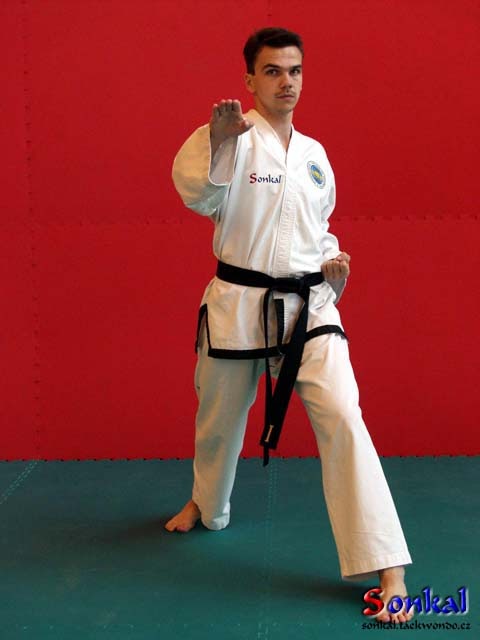
Showing posts with label fundamental movements. Show all posts

10 July 2022

Quick Notes on Basics and Fundamental Movements

A while ago I was scanning through this blog searching for a post on "Basics", which I was certain I wrote years ago. In my memory the title of the post was something along the lines of "Prototypical Movements". However, to my frustration, I couldn't find the post I was looking for. The closest I got to it was a paragraph written in another post on the value of the patterns. Then I thought, maybe I had written the essay, but possibly forgot to post it, so I searched for it in my old Taekwon-Do folders, but that search came up empty as well, except for a short passage in a draft document in which I discuss Taekwon-Do's pedagogy. It is a pity that I can't find the text I thought I had written; it might be that it was completely conceptual and I just never got round to writing it. The gist of the idea is that there exists a category of movements that are more foundational than the Fundamental Movements, and time spend on trying to distill and understand these "basics" are of immense value. I decided to post the excerpt from the aforementioned draft below:


Notes on Basics and Fundamental Movements


Fundamental movements are the vocabulary of Taekwon-Do. Each fundamental movement is a specific identifiable technique using a specific stance and specific (attacking or blocking) tool aimed at a specific target on the opponent and which can usually be found described or alluded to in the ITF Encyclopedia. These individual techniques should first be taught by a qualified instructor. Thereafter, the practitioner can easily practise these movements by themselves. There is no question as to their importance and even grand masters will often go back and practice specific fundamental movements. 


There are supposedly over three thousand individual fundamental movements in Taekwon-Do. A common error people make is to try to accumulate techniques…trying to learn each of these hundreds of movements. This is not a good approach. A much better approach is to practice the basics and grasp the underlying principles. 


I differentiate here between fundamental movements and basics (basic motions), which are the gross motor movements that fundamental movements share. If fundamental movements are the vocabulary, the words, of Taekwon-Do, then basic motions are the phonics, i.e., the sounds used to make those words. Put differently, basics are the building blocks of fundamental movements, and many fundamental movements use nearly the same basic motions. There are far fewer basic motions, and one is exposed to all the important basics very early on, probably within the first few colour belt patterns. To excel in Taekwon-Do, it is better to identify and perfect the basics (gross motor movements), rather than try to amass all the individual fundamental movements.


I will give a few examples. First, each stance should be considered a basic and transitioning between stances are basics as well. Next, the shared gross motor movements used in techniques are what constitute most of the basics. For instance, the pulling-hand that is brought to the hip with nearly every punch or thrust is such a basic. The difference between a walking stance high or middle front fore fist punch, a long fist punch, an open fist punch, a flat-fingertip thrust, a twin-fingertip thrust, and an arc-hand thrust is almost entirely based on changing the unformed hand into a different attacking tool moments before impact: the overall gross motor movement is almost exactly the same for all these punches and thrusts. Similarly, the outer-forearm outward blocks (irrespective if they are high, middle, or low), the knife-hand blocks, and even knife-hand side strikes share another basic motion—the arm is brought across the body with the palm facing somewhat up, and then moved towards the outer edge of the body while the arm rotates so that the palm faces the other way. Rather than learning these fundamental movements as individual techniques, it is better to ingrain the gross motor movement of the arm and body and only learning to adjust the end positions appropriately. You will also notice that many fundamental movements are simply a basic movement (gross motor movement) stopped somewhere else along a trajectory. For instance, a middle vertical punch is simply a regular middle punch that stopped short of its target; a knife-hand block is a knife-hand strike before full extension; a knee kick, such as a front or turning knee kick, is a regular kick without the final snap of the lower leg. 


In short, there are few gross motor movements to master, and each fundamental movement requires only slight tweaks to differentiate between them. I don’t mean to suggest that you do not need to practice fundamental movements; however, focusing on mastering the basics—the gross motor movements—will bare much more and faster results as the principles in one basic motion are directly applicable to all the different fundamental movements that share that basic motion.  


Fundamental movements are often trained on the spot or as line drills while stepping, sliding, dodging, or jumping forwards or backwards. This is appropriate, although I would also add side-steps, and diagonal movements as part of such drills. Furthermore, once a fundamental movement is understood and done with relative mastery, it is much more useful to practice combinations of fundamental movements, rather than one fundamental movement at a time. It is good to practise combinations of fundamental movements that seem to fit logically together and have a sensible flow. The Korean term for such sequences is pum 품, which are the sequences of movements that make up the patterns. It is very important to practice the pum from a pattern before practicing the pattern in its entirety. 


(Occasionally instructors may also combine sequences that are unnecessarily difficult, i.e., that do not have a natural flow to them. This challenges both body and mind and few things encourage learning than struggling to figure out a complex problem.)


While line drills and pum-practice for lower ranks are trained according to movement principles associated with “traditional” movement, higher ranking practitioners can transcend such formalized training and move in a “freer” manner, with stances and rhythms that are less fixed—by practicing the combinations as if they are doing free sparring. In other words, the drills are more akin to “shadowboxing”. This does not mean that the formal stances and rhythms are thrown out the window. Instead, traditional stances and rhythms are moved in and out of dynamically, rather performed in a fixated “traditional” manner.
 

14 December 2016

Arc-hand thrust


In Taekwondo the arc-hand thrust #반달손 #뚫기 is often used to attack the throat (trachea).

In ITF Taekwon-Do the other hand is sometimes used to pull the opponent closer while simultaneously attacking the throat. One hand thrusts, while the other pulls. This yin-yang (음양) type movement is one application of the so-called Reaction Force principle, that is part of ITF Taekwon-Do's "Theory of Power".

A common variation in Taekkyun 택견 is as a #takedown: the arc-hand pushes the opponent's throat or even face, while the other hand is used to reap one of the opponent's legs, and so topple him.

#koreanmartialarts #martialarts #fundamentalmovement #무술 #무도 #무도인 #사범 #호신술 #selfdefense

☯️

www.thewaymartialarts.org
http://sooshimkwan.blogspot.kr

09 February 2013

The Value of Patterns (Part 2): Kinaesthetics (Part 1: Relaxation, Body Awareness, and Spacial Awareness)


Me practicing Fundamental Movements
In previous posts I shared my opinion about the value of the ITF patterns. First I said that the patterns are not foremost fighting templates, nor are they primarily dallyeon (i.e. strength & fitness training). Then what is the primary reason for training in the patterns?

The main purpose, I believe, is Kinaesthetics. The patterns teach us a way of moving and understanding movement that is difficult to isolate and acquire through other drills.

The following comment by Master Manuel Adrogué's provides a good abstract to much of what this discussion will be about: “In ITF patterns there are no physical conditioning exercises, no applicable combat strategies, there is no hurry to conform to fast combat rhythm, just perfectly balanced, powerful techniques using all [the] time they may need.  Additionally, the emphasis on relaxation in ITF Taekwon-Do, to the point of completely shunning muscular force, educates students in correct habits of motion.”¹

I will discuss what I consider the kinaesthetic values of the ITF patterns over three posts. In this one I will look at conditioning relaxation; creating an awareness of one's equilibrium and body movement; including ingraining balanced and appropriate stances and basics; as well as creating spacial awareness. In the second post I will look at the value of learning how to accelerate one's body mass sequentially. In the final post post I will discuss training rhythm and breathing.

Relaxation


First, the ITF patterns, with their relatively slow tempo and emphasis on the sine wave motion, teaches the practitioner to relax. The full sine wave motion starts with deliberate relaxation. To perform a pattern correctly you must move from a state of relaxation, or as Grandmaster Rhee Ki Ha puts it: "relaxed, light, and fluid"². Any unnecessary tension, except at the moment of impact, makes the movement lose its "relaxed, light, and fluid" quality. Unlike some Karate kata where muscular tension is encouraged for the purpose of strength conditioning, in the ITF patterns muscular friction is particularly avoided. The only time muscles are tensed are at the final moment of the technique just before impact with it's target.

A primary function, then, of the ITF patterns is to condition one to move in a "relaxed, light, and fluid" manner. Using the pre-arranged sparring drills, the practitioner is guided to transfer such relaxation into combative activities. In the basic pre-arranged sparring exercises, such as three step-sparring, the practitioner will apply the same relaxed tempo to this drill. The practitioner therefore learns to stay relaxed even when facing an opponent (training partner).

As the practitioner progresses in level and skill, the complexity, difficulty and tempo of the drills are increased, moving along a continuum of very predictable drills with a low amount of variables, towards much less predictable (chaotic) drills with an increased amounts of variables that more closely reflect a real combat situation. (Read more on how this is supposed to work in my post on The Value and Purpose of Prearranged Sparring.)

If properly practised, the sense of relaxed movement that are continuously instilled through pattern practise is transferred into the other aspect of the system. This means that skilled practitioners are able to move with a similar relaxedness, lightness and fluidity that were instilled from the patterns, but at much quicker tempos as are required in more realistic combative training.

To me, this point—moving from a state or relaxation—is probably the most important reason the ITF patterns are performed the way they are.

Equilibrium and Body Awareness


The second kinaesthetic value of the ITF patterns is that their relatively slow tempo allows the ITF practitioner to become aware of both their static and dynamic balance. Because the ITF patterns are not considered combat-ready templates that mimic actual real combat, there is no need to rush them as if one were actually fighting. In fact, the tempo of the patterns are deliberately slowed down to allow the practitioner to become aware of the body mechanics and physics of each technique individually.

In other words, by doing the patterns so slowly, compared with the urgency with which the forms are performed in some other martial arts, the ITF practitioner has the time to really "feel" how their centre-of-gravity changes, how their weight shifts from one foot to another, how their mass moves through space, how the different parts of the body is sequentially activated to create a whip-like motion.

A Tai Chi Chuan practitioners usually perform their forms
in a consciously slow fashion.
Image Source
Both the previous point of conscious relaxation, and this point regarding a deliberate awareness of one's equilibrium and weight-shifting are goals the ITF patterns share with the Tai Chi Chuan forms. It would be ridiculous to suggest that a Tai Chi practitioner would engage in a fight applying the same slow motion tempo one sees them doing while performing a Tai Chi Chuan form. Obviously the Tai Chi practitioner would have to adapt his or her form to make it “combat applicable”—for one, the practitioner would definitely have to speed-up his or her movements. Why then does Tai Chi Chuan spend so much time practising their forms in slow-motion? The reason, I believe, is in part that the slow motions forces one to relax more, but also it really increases one's awareness of how your body moves through space, how your centre of gravity changes, how your weight shifts from one foot to the other. The moment you start rushing your movements it becomes exceptionally difficult to really become aware of the dynamics of such changes in one's balance and body structure. Rushed movements shift the focus from the “journey” to the “destination”. While there is much value in speed training (i.e. getting to the destination as quickly as possible), there is just as much value in understanding the variables along the path, and the latter is only truly achievable at a slower, contemplative tempo.

Ingrained Stances, Basics & Coordination 


Not only is the practitioner learning about balance and weight-shifting, but very importantly, the practitioner learns how different stances provide different types of structure and balance for different types of attacks and defences. The walking stance is strong from the front and back, but weak from the side; the sitting stance is strong from the side or when posting ("falling") against something but one can easily be pushed off balance from the front or back; the rear-foot stance (aka “cat-stance”) is good for withdrawing from an attack and counter-attacking with the leading foot, but it is not very stable as your balance is centred mostly over one foot only; and so on.

When moving through patterns, one shifts from one stance to the next stance, doing different steps and pivots; in so doing, the practitioner starts to acquaint him- or herself at a subconscious level with these stances within a dynamic context. Over time the practitioner finds that he or she almost automatically chooses the most appropriate stances for different tasks and situations. Such "automatic" responses are not accidental, but have been ingrained during years of pattern training.

(Read more about this in Dan Djurdjevic's post on “Kata, kinaesthesia, proprioception and motor learning”.)

Furthermore, certain types of movements which often uses gross motor skills become ingrained to form “basics”, which can be adjusted depending on what a situation calls for. Basics are different from Fundamental Techniques. It is rumoured that ITF Taekwon-Do has about 3200 Fundamental Techniques. Each one of these Fundamental Techniques is a specific identifiable technique using a specific stance and specific tool (e.g. attacking or blocking tool) aimed at a specific target on the opponent and which can usually be found described or is alluded to in the ITF Encyclopaedia.

A snap shot of an Intermediate Position
There are much fewer basics and one is exposed to all the important basics very early on, probably within the first few colour belt patterns. Basics are often embedded in the Fundamental Techniques and function as building blocks from which different Fundamental Techniques are constructed. An example of such basics is learning to move through the Intermediate Positions. Acquiring a sense of the intermediate positions is probably one of the most important kinaesthetic values of pattern practise. The problem with the intermediate positions is that they are dynamic, rather than static positions. In other words, unlike Fundamental Techniques that have an “end-position” in which we can pose statically, the intermediate positions are moments inside of movements and attempting to pose in them detract from their value. The only way to really get a sense for them is by practising them dynamically; i.e. while moving from one Fundamental Technique to another, and for this pattern practise is ideal.

Dan Djurdjevic compares what I call the basics, i.e. these “building blocks”, with stem cells that can change into whichever “cells” are required. Since he already explained this concept in detail, I will not repeat it here. Please read his post on “Kata Techniques as Stem Cell Movements”.

I need to also momentarily comment on coordination, which might be taken for granted, yet this is a point which is close to my heart. As a kid I had terrible coordination. Taekwon-Do, which I started as a teenager, has done much to improve my hand-eye (and foot-eye) coordination. Obviously all physical activity contributed to my improved coordination, but I believe that the patterns have a special value in this regard because of their systematic nature. I still vividly remember how difficult it was for me to master those very first forms, Saju-Jjireukgi and Saju-Makgi. It is surprising how many things occur during just one Fundamental Movement and for a beginner even something as elementary as the Saju-forms, that each consist of only two movements combined in a sequence, can prove to be quite daunting. The brain is wonderfully challenged and improved coordination is a great benefit. As a child I often missed catching something thrown at me; now, I sometimes catch things even without thinking. For instance, I'm often surprised how I would catch something that might fall from a table, without me even consciously trying to—it just happens reflexively. Whenever that happens I cannot help smiling, thinking of how far that clumsy teenager has come, and I'm certain the patterns played a part in that. The patterns are arranged according to certain levels of complexity and physical difficulty, causing a systematic development of ones coordination and other related skills.

Spacial Awareness


Another kinaesthetic value of the patterns is that it enhances one's spacial awareness.

Generally Asian cultures and cultures of the Far East in particular are group-orientated. An interesting feature of group-oriented cultures is that the personal space between people are often much smaller than is the case in individual-oriented cultures. This has some serious self-defence implications.

Let me make a quick detour through Thailand and then turn back to Korea again. A friend of mine, the actor and stuntman Damian Mavis who is also an ITF Taekwon-Do practitioner, resides in Thailand. On one visit with him we got to talk about personal space in Asia. He told me how easy he found it to sneak up on his Thai friends even from the side because of their sense of personal space which is so small. Similarly in Korea, standing or sitting on the subway with people's shoulders literally pressed against one another is not perceived as uncomfortable by Koreans. Likewise, when standing in a line, people often stand very close to each other. Personal space in the Far East is quite small and personal space to the rear and side is exceptionally small from Western standards. Furthermore, large, sudden movements are considered rude and improper in the conservative, group-oriented cultures of the Far East, influenced by Confucian standards of conduct.

I find it not surprising that the patterns which are based on the Japanese kata make such large movements, uses exaggerated long steps, and focus on turning at right angles and 180° pivots, forcing the practitioner to become aware of his or her sides and back just as much as his or her frontal space.

I hypothesize that the kata was, at least in part, developed to help the practitioner to break through his or her culturally induced small personal space, and actually to enlarge it. Obviously a larger and wider personal space will increase ones spacial awareness, which is a valuable skill for self-defence. If your personal space is larger, you become aware of people entering your personal space much earlier, which is very important for detecting threats earlier.

People are often narrowly focussed on what is in front of them; however, many attacks on one's person are surprise attacks launched from the side or behind. Widening one's spacial awareness to things on your sides and rear is a crucial skill for self-defence, and even more so for people from the Far East whose personal space is culturally smaller and narrower.

Although I have emphasised how the ITF patterns are used as a vehicle for bestowing Korean traditional culture, paradoxically, in this way the patterns (including the Japanese kata) seem to break with common Oriental culture by actually enlarging and widening their personal space.

Conclusion


The kinaesthetic value of the ITF patterns is concerned with teaching the practitioner to move from a state of relaxation. Furthermore, the patterns focus on body awareness (getting acquainted with one's static and dynamic balance), and spacial awareness, while also ingraining certain stances, basics, and increasing coordination.


1.  Manuel Adrogué , “ITF Taekwon-Do and Sine-Wave as 'Sequential Motion'”
2. Rhee Ki Ha, “This is Taekwon-Do”

15 April 2012

Poetry in Motion: A Poetic Interpretation of the Patterns

In a recent post on the value of patterns (Part I) I referred to the essay below, which was published in Totally Tae Kwon Do magazine, Issue #15. Since I plan to soon continue my discussion on the value of patterns, I thought it good to also post the essay here.

Poetry in Motion: A Poetic Interpretation of the Patterns

I cannot remember if it is how my instructor introduced patterns to me or if my own love of poetry sparked the comparison, but I have always regarded patterns as poetry in motion.

One of the things I do to fill my life with meaning is to teach literature, and particularly poetry, as a university lecturer. As a scholar of poetry I am sensitive to what is sometimes known as poetic devices; in other words, the different techniques poets use to craft their verse. As a scholar of Taekwon-Do I have found that some of the same “poetic devices” are present in the patterns.

I have always thought of the individual techniques as words and compared combinations of techniques to phrases. A poem is a composition of aesthetic phrases. A Taekwon-Do pattern is a composition of combat combinations (a number of combat techniques flowing into a sequence).

There are numerous parallels I find between poetry and patterns; one poetic device which is worth considering is probably the one most people associate with poetry, namely rhyme. Many an aspirant poet makes the grave mistake of thinking that poems have to rhyme and will therefore force verse lines to end with rhyming words in an arbitrary fashion. This makes anyone well read in poetry cringe as we know that the mere presence of rhyme does not guarantee good poetry. The result of such forced rhyme creates, at best, cute nursery rhymes. While the master poets may employ rhyme, it is never used arbitrarily—rhyming just for the sake of rhyme. Instead, since every rhyme causes the rhymed words to stand out, the poet knows that emphasis is given to rhyming words. Rhyming is therefore used to emphasize meaning and to create semantic significance between words.

Following I would like to give some examples from the Chang Hon patterns of “rhyme” and how being aware of such rhyming can help you understand the patterns better.

Let’s consider the pattern Chon-Ji. If I were to ask you to identify the rhyme in Chon-Ji you would most likely tell me that the movements that are performed on the left-hand side are repeated on the right-hand side. Such an assessment would be correct. There are many repetitions of movements on different lines, all constituting “rhyme” in Chon-Ji. However, to really get value out of these observations one needs to ask how the rhyming gives meaning to the rhyming parts, i.e. to the similar movements. If it is merely the repetition of the same movements in symmetrical fashion purely for the sake of repetition (i.e. symmetry), there is no real deeper meaning. What we have then is merely a nursery rhyme.

Mr. Jaroslaw Suska performs the pattern Chon-Ji in the video below. 


(It may be true that the lower ranking patterns have some nursery rhyme quality to them, and that is as it should be. A child immediately introduced to T. S. Eliot’s “The Wasteland” would be completely ill equipped to understand it. No, the child should first learn the nursery rhymes and then progress to, maybe the Romantics, next be exposed to Dickinson and Whitman, later to some of the Imagists and other Modernists, and then only do you expose them to T. S. Eliot; for only after a systematic progression in poetic difficulty is the reader equipped with the tools and experience to understand the grand poems, such as “The Wasteland.” So too martial art practitioners and especially novices should progress systematically through the patterns and not be too eager to learn new patterns until they have thoroughly familiarized themselves with the material at their current level.)

In trying to understand poems, one should endeavor to allow the poems to interpret themselves. Permit different poetic devices, such as rhyme, to highlight certain ideas or “significances.” Such significant ideas then become what we may call “motifs,” which are the controlling ideas of the poem. One should not merely be aware of the symmetrical repetition of movements, but should pertinently look for meaningful repetition. It is this meaningful repetition that I will henceforth refer to as “rhyme.” Here is an example of meaningful repetition that creates a motif in Chon-Ji. One “rhyme” in Chon-Ji is the middle section attack—the walking stance middle front punch. Another “rhyme” in the pattern is the inner forearm outward middle block.  These two techniques, the middle front punch and the middle front block creates one motif. What the practitioner learns is that the solution to a middle front punch is a middle front block. Such “problem-solution” motifs are rampant in the patterns. Take for instance the black belt pattern Choong-Jang. The solution to the knee kick, movement #19, is provided later as the twin palm pressing block, movement #24. Often an earlier technique seems to anticipate its counter later in the pattern.

Using an inner forearm outward block in an L-stance, Jay Kang (red belt) defends against the punch by Tae Hyeong (green belt). Both the problem (the walking stance front punch) and the solution (the L-stance inner forearm outward block) are derived from the pattern Chon-Ji. 

Another type of rhyme that causes a motif is when the same technique is repeated with different variations. For instance in the pattern Toi-Gye the X-block is used twice, but in different ways. It is used first, in movement #7, as a walking stance pressing X-block and second, in movement #29, when one jumps into an X-stance pressing X-block.


Being attentive to such rhyming and motifs in patterns, one can often find solutions to questions. In a previous issue of Totally Tae Kwon Do Michael Munyon raised a question along these lines:
“In Yul-Gok, why do we perform movement #1 as a measuring technique at the shoulder line yet we strike center line? What is the purpose of the measure and why are we measuring at that rank versus an earlier rank?” 
Mr. Jaroslaw Suska performs the pattern Yul-Gok in the video below. 


In other words, what is the function of this “measuring technique” (movements #1 and #4)? As a scholar of poetry, and reading the patterns as poems, the answer is to me quite obvious, but allow me to guide you through my analysis.

This specific combination consists of three movements. The first movement moves the arm in a slight arc horizontally to the outside in line with the shoulder line. It is then followed by an attack (two double punches). The rhythm is first slow (or at least at normal pace), then accelerated. Where else in Yul-Gok do we find this motif: a motion where the arm is moved in a slight arc towards the outside followed by an attack, with the rhythm starting out normal but then accelerated? Actually, we find this motif repeated for at least two other unique combinations. The first other unique combination that starts with an arm moving horizontally to the outside followed by attacks (with progressive acceleration) is the sequence of movements starting at #7 (#7-10 or #11-14)—the inner forearm outward block, followed by a front snap kick and the two fast motion punches. The same motif, but again a different combination of techniques, is encountered at #15-17 or #18-20. The palm hooking block moves the arm out horizontally in a slight arc to the shoulder line, then the rhythm is accelerated as the next palm hooking block and front punch is done in a continuous motion. Although the second technique in this combination is a block and not an immediate attack, the general tone is similar to the previous combinations. (Mr Anslow picked up on this tone and therefore aptly proposed in his Ch’ang Hon Taekwon-Do Hae Sul that alternative interpretations for the second palm hooking block is to understand this second movement as an “attack” to manipulate the opponent’s head.)

Keeping our motif in mind, let’s return to our original combination, the “measuring technique” followed by the two attacks. The other two combinations clearly show that in each case where the arm is moved horizontally and in a slight arc to the shoulder line (an inner forearm outward block or a palm hooking block), it functions as a defensive technique. Using the poetic interpretive method the “measuring technique” ought also to be interpreted as a block. Well, in the general way it is performed, is it closer to the inner forearm block or the palm hooking block? Certainly the hooking block. In my assessment, the “measuring technique” is nothing other than a hooking block with the forearm, instead of the palm, used as the blocking tool. Consider the application: Your opponent is in front of you and attacks your middle section with a punch. You step into a sitting stance, simultaneously moving your forearm in a slight arc horizontally to the side, intercepting the oncoming punch with your outer forearm and redirecting it to the side. You then follow up with two well placed punches to the ribs of the attacker, which will be on your centre line.

The three photos above illustrate the first three movements in the pattern Yul Gok. When Jay Kang (red belt) is attacked with a front punch by Tae Hyeong (green belt), Jay Kang steps off the centre line into a sitting stance while redirecting the oncoming punch with a forearm hooking block (i.e., “measuring technique”), then counter attacks with two punches to Tae Hyeong’s ribs. 


The question raised by Michael Munyon included “why are we measuring at that rank versus an earlier rank”? If one understands this “measuring technique,” as I have proposed, to be a forearm hooking block, then it is simply a similar situation like we saw in Toi-Gye where the same technique is merely repeated in different variations. It is not that we are suddenly introduced to a measuring technique at this level; rather, it is that we are introduced to hooking blocks (both the forearm hooking block and the palm hooking block) at this level.

A poetic reading of the patterns can aid you in identify motifs in the patterns. This will help you see connections within the pattern that may otherwise go unnoticed. It can also be a method of interpreting the patterns and finding solutions to some questionable techniques. Apart from rhyme, other poetic devices such as understanding how verse lines function (either as end-stop lines or run-on lines); rhythm created through the use of stressed and unstressed syllables; rhetoric devices such as repetitions and parallelism; figures of speech like imagery, simile and metaphor; and so on, can all assist in interpreting the patterns. Of course, the poetic reading of patterns is not the only interpretive method available. Other methods of interpretation may include an interpretation focused on martial strategy, or an interpretation focused on self-defence application. However, since patterns are probably the most specifically aesthetic segment of the art, it would make sense to augment your interpretation of the patterns by also employing methods of interpretation that focus on patterns as works of art. While a poetic interpretation is one such a method as this essay proved, one could easily apply interpretations methods borrowed from other art forms, like interpretative methods from the visual arts (e.g. painting and sculpture) and performing arts (e.g. dance). Using a variety of interpretative methods will enhance and enrich your study of the patterns.

19 September 2011

Another Perspective on the Reaction Arm

I wrote about the reaction arm in fundamental techniques, particularly traditional punching, a few weeks ago. In that particular post I basically said that there are two main views regarding the function of the reaction arm. The one view sees it as critical for maintaining proper structural balance. The second view holds that these reaction arms act as pulling techniques. Therefore, an interpretation for a traditional punch would basically be that you pull your opponent towards you with the one hand (reaction hand) while pommeling him with the other. There is a third view which I did not mention in that post, partially because it is such a very traditional view that is dismissed by many people, and because it doesn't apply to most techniques—only a small group of techniques may actually benefit from this interpretation of the reaction arm.

This third view considers the spine of the body as one's central axis and your arms as extensions on opposite sides of each other that rotates around this axis. There are two objects that can help you envisage this view.

A Korean pellet drum,
which is called a do 도 in Korean.
The first object is a pellet drum, known in Korean as a do 도 / 鼗 or nodo 노도 / 路鼗. A pellet drum has two membranes on opposite ends of the barrel. On the sides of the barrel are two strings with pellets attached at their ends. A pole is attached through the drum (through the barrel, not the membranes).


A Japanese pellet drum toy,
known as a denden daiko でんでん太鼓.
One plays a pellet drum by swiftly rotating the pole in one direction and then in the other direction, which causes the pellets to swing because of the centrifugal force that occurs when the pole is rotated. The pellets hit the membranes and create sound.

Aeolipile, aka Hero's Steam Engine
The second object is an aeolipile, sometimes refered to as Hero's steam engine, after Hero of Alexandria that described its mechanics in the first century A.D. An aeilipile is basically a boiler that is so set-up that it can rotate around an axis. On opposite sides of the boiler are two curved nozzles pointing in opposite directions to each other and perpendicular to the axis of the boiler. When steam escapes from these nozzles, thrust is caused, based on the the rocket principle in accordance with Newton's Third Law of Motion. This causes the boiler to spin around its axis.

Both objects are somewhat flawed to describe what happens in the human body in the third view of the reaction arm. Nonetheless, they help to illustrate the underlying idea. Note that in both cases there is a pair of opposing elements: the two strings-and-pellets on the drum and the opposing curved nozzles on the aeolipile. In both cases the pair of opposing elements rotate around a central axis. The traditional martial art idea is that the one opposing element contributes to the force of the other opposing element. In other words, by forcefully swinging my arm in one direction, this adds to the force of the other arm moving in the opposite direction.

Me trying out Pak Hok Pai in Hong Kong
In some of the Chinese martial arts one sees this idea flamboyantly applied. Sometimes the arms are literally flung in opposite directions just like the strings-and-pellets on the pellet drum. A good example where this idea is applied is Pak Hok Pai, the (Tibetan) White Crane Kung Fu system.


There is definitely power in these techniques caused by the centrifugal force, but I would be hard pressed to say that the arms moving in opposite directions cause the noticeable force in each other. It is probably more correct to say that the arms swing because of the centrifugal force. It is not the arms in themselves that cause the force. It is easy to demonstrate that the arms do not directly influence each other's reaction to the centrifugal force. Stay on one spot and then start to spin around, keeping both arms relaxed so that they naturally swing away from your body because of the centrifugal force acting on them. Now bring one arm towards your body, keeping it tight against you. The fact that this arm is kept from acting on the centrifugal force, contrary to the other arm, does not influence the other arm from still swinging normally as before while you keep on spinning on the spot. The essence of the force, therefore, lies not in your arms working in opposite directions, but lies in the actual rotation of your body that is spinning around an axis. (What is properly influenced when you use only one arm during this spinning exercise is your balance. You have better equilibrium with both arms out.)

The important thing is therefore not the opposite directions that your arms are moving in; the important thing is the rotation of the body around its axis which causes centrifugal force. While I don't believe that the arms moving in opposite directions contribute to each other's force, that doesn't mean that they could not contribute in another way. If pulling back my arm helps me in rotating my body around it's axis faster, then it can actually influence the centrifugal force, which in turn will influence the other arm.

Sanko's Imaginary Jet-Propelled Rotating Glove-Weapon

To explain this, imagine a ridiculous weapon I invented for this post that works similar to an aeolipile. The weapon is made up of a structure with two beams attached at opposite ends of an axis. At the far end of one of the beams is the attacking tool—a boxer's glove—attached perpendicularly to the beam. Perpendicularly attached at the far end of the other beam is a rocket engine. The jet propulsion of the rocket, in accordance with Newton's Third Law of Motion, causes the structure to rotate around the axis, resulting in the glove hitting a person standing close by. We see here that the beam moving in one direction causes the motion of the beam moving in the opposite direction—the glove's force is equal and opposite to the force of the rocket.

Speaking of this principle of Reaction Force, i.e. Newton's Third Law of Motion, the ITF Encyclopaedia states that “A punch with the right fist is aided by pulling back the left fist to the hip” (Volume 2, p. 15). The encyclopaedia doesn't expand on this topic, so it is unclear how pulling back the left fist contributes to the punch with the right hand. The only way I see this to be feasible is if the reaction arm (the one that is pulled back) contributes to the acceleration of the body's rotation around its axis. This in turn will help to push the punching arm which is structurally on the opposite side of the body, just like the glove is opposite to the rocket as depicted in my imaginary weapon.

Many traditional martial arts are of the view that the reaction arm contributes to the force of the acting arm; that pulling back the non-punching arm aids the punching arm. It must be remembered, however, that the reaction arm is not directly affecting the acting arm; instead, it is possible for the reaction arm to contribute to the rotation force of the body. If the reaction arm is not positively affecting the rotation of the body around its axis, then it is not contributing to the force of the strike. On the other hand, if the reaction arm contributes to the rotation of my body around its axis, then it may very well contribute to the force of the punching arm.

It is important to remember, as I mentioned at the beginning of this post, that only some techniques—those that potentially benefit from centrifugal force—will benefit from the reaction arm in this way. For many techniques the reaction arm does not contribute to centrifugal force; instead it contributes to better structural balance and its associated benefits.

Read the previous post on "The Reaction Arm."

31 August 2011

The Reaction Arm

The reaction arm in traditional martial arts punching and other fundamental movements is quite controversial. The reaction arm is, for instance when doing a front punch, the arm that is pulled back to the hip, while the other fist is flung to the target. Although controversial, for the traditional martial artist there are many proposed reasons for employing the reaction arm. In this post I will mention the two most prominent reasons that I am aware of, as this topic is viewed within ITF Taekwon-Do.

A front fore fist punch with the
reverse arm pulled back towards
the hip. (Image Source)
First, the “reaction arm” functions exactly as its name implies, as a reaction to the punching arm's action. This has a counter-balancing effect. If you were to punch with all your strength and with your whole body weight behind the punch, the resultant force will actually jerk you off balance. Always keeping good structural balance and good posture is paramount in traditional martial arts as the moment you are off-balance or your body structure is unsound, you are strategically disadvantaged, something that your enemy can exploit.

A lot of Taekwon-Do training occurs without hitting an actual target and many of the punches and kicks are done in the air, without any contact. During such training the reaction arm is crucial for keeping good balance and structural alignment. Not doing so may lead to bad habits and overextension of joints, which could lead to long term ailments. However, when you actually do hit something, the reaction arm is not necessarily required because the object you are hitting is providing the reaction force as we know, based on Newton's Third Law of Motion. In other words, when you train against a punching bag or when you actually hit a person, you may at times, and sometimes should, opt to do it without the reaction arm. In ITF Taekwon-Do we actually see this. Certain training is done with the reaction arm (e.g. fundamental technique training), while other exercises are done without the reaction arm (e.g. tournament sparring drills). The discrepancy doesn't mean that the one is “traditional” and the other “practical,” it merely means that one form of training assumes more force that could affect your structure and another form of training that assumes that you will be hitting actual objects.

A knife-hand inward strike with
the reverse arm covering the torso.

(Image Source)
Furthermore, some reaction arm techniques, while aiming to ensure proper balance, also act as guards, covering vital spots on your anatomy. Take for instance the knife hand inward strike where the reaction arm covers the front of your body which has many targets that are potentially easy for your opponent to reach at this close distance. There are quite a number of techniques where the reaction arm seem to have this auxiliary defensive function.

Me demonstrating an arm
bar: pulling with one hand,
while pressing with the other.
The second interpretation for the use of the reaction arm is that it functions as a pull. This is another example where ITF Taekwon-Do seem to base its technical philosophy on Newtonion physics. In this case it suggests that a technique will be more forceful if one combines the oncoming (pulled) momentum of your opponent plus the forward momentum of your own strike. Basically, one can actually pull your opponent into your punch and this will theoretically increase the effectiveness of the strike. It also prevents your opponent from dodging the attack. This is not something one see in most combat sports, not because it is not feasible, but probably because of the nature of the sport and sport equipment—sport rules that discourage grabbing or gloves preventing you from grabbing. When one look at gloveless combat sports like certain forms of Karate, one does occasionally see such pulling-while-punching techniques as in the video below. I personally also like to teach applications where the reaction arm is used to great effect as a grab and pull while attacking with the other arm. This combination of pulling and pushing is a common theme in martial arts.


These are the two main ideas regarding the reaction arm in ITF Taekwon-Do. The first is that it acts as a reaction force that helps with proper balance and postural structure, which is especially necessary when practicing without the presence of a physical target. If you do hit an actual target you may often omit the reaction arm because the object will provide the reaction force according to Newton's Third Law of Motion. The second interpretation of the reaction arm is that it functions as a pull, which combines with the forward momentum of your attack, resulting in a more forceful collision. The reaction arm may also be part of other pull-push combination techniques.

What are your thoughts on the reaction arm?

Read my follow-up post on the reaction arm, which presents a third view based on centrifugal force: "Another Perspective on the Reaction Arm."

10 May 2011

Sine Wave and Motion

I realised that I've never actually properly explained the basic understanding of the sine wave motion on this blog. I've always assumed that readers of this blog know what I'm talking about and from there move onto a deeper interpretation of the sine wave motion. So, herewith, the sine wave motion as it is typically understood by most ITF practitioners. The following is something I wrote many years ago and is part of the Soo Shim Kwan handbook. (My understanding of the sine wave motion has evolved since I originally wrote this.)


Sine Wave and Motion

By Sanko Lewis with references to the ITF Encyclopaedia and the essay: “Pattern Speeds and Sinewave Study” by Paul McPhail (VI Dan) – www.itfnz.org.nz (2004).

The sinewave-motion is a method of power generation utilized by ITF Taekwon-Do. The obvious purpose of sinewave is to lift the body mass, thereby increasing potential energy and then converting the stored energy into kinetic energy by dropping the body mass into the technique. Taekwon-Do techniques, therefore, usually work in a natural partnership with gravity.

The above description only explains the last half of the total sinewave-motion. A full sinewave-motion involves that the body is first relaxed (dropped) prior to the raising and dropping of the body mass.

The aim of this initial part of the sinewave-motion is to consciously relax the muscles. Following below is a list of reasons why relaxing is advocated:

  • In a stressed environment the musculature have a tendency to tense up. Relaxed muscles are faster and more reflexive than tensed muscles.
  • Naturally bending the limbs, specifically the legs, allow for better thrust.
  • Lowering the centre of gravity contributes to a balanced initial foundation from where the technique can commence.
  • Relaxing the muscles reduce the unnecessary use of energy.
  • Muscle cells uses up ATP-energy when active. Cells only need a short time of relaxation to produce ATP.
  • Relaxed muscles ensure smooth graceful motion.
  • Conscious relaxation helps to focus the mind on the task at hand; mentally preparing for attack or defence.

“The relaxation desired is relaxation of muscles, rather than of the mind or attention.” – Bruce Lee.

At the beginning of the sinewave-motion the body is relaxed, the limbs slightly bent and the mind focussed.

The middle part of the sinewave-motion, when the body mass is raised, usually coincide with the backward-motion referred to in the Training Secrets of Taekwon-Do. The raising of the body mass is achieved by raising the hip as suggested in the Theory of Power – Mass.

As for the last part of the sinewave-motion, the body mass is not merely dropped down, but is usually accelerated down at the end of the sinewave-motion. This is achieved by utilizing the knee-spring action and by jerking the hip (rotating the waist) in the direction of the attacking or blocking tool as described in the Theory of Power – Mass. (There are some exceptions.) Power should be unleashed gradually throughout the sinewave-motion and must achieve maximum acceleration during this last part, specifically at the point of contact with the opponent’s body. Every muscle of the body must be concentrated towards the appropriate tool at the proper time. (Refer to the Theory of Power – Concentration.)

The down-up-down motion of sinewave should always be performed smoothly like a wave in water. The motion is never performed jerkily (saw-tooth motion) as this will in fact reduce accumulated momentum.

  • Full sine wave motion requires that the body is relaxed (down); the mass is then raised (up); and completed by finally dropping the body mass into the technique (down). This down-up-down motion completes one movement / technique with full sinewave. 
  • 2/3 sine wave motion means that upon completion of the first movement, the practitioner immediately moves up and then drops the body mass down to complete the next movement (up-down). 
  • 1/3 sine wave motion means you are already up at the completion of the first movement and only drops down into the next movement (down).

Fundamental movements (e.g. in patterns) may also be described according to the particular speed, tempo-quality of the technique, the method of breathing used, and attitude of the performer.

  • Normal motion is the speed and tempo at which individual movements / techniques are normally performed in patterns; with the usual characteristically short-sharp exhalation (normal Taekwon-Do breathing) and full sine wave motion.
  • Slow motion movement is performed slowly with slow breathing. This is used to emphasize an important movement and to check balance and control. The tempo of slow motion is about four times that of normal motion. The attitude is that of focus and concentration.
  • Fast motion is performed urgently and aggressively with normal breathing, i.e. one short sharp exhalation for every technique. Fast motion is nearly always attacks, usually two punches. The sinewave is cut short; springing straight from the first movement into the next.
  • Continuous motion links movements together with no pause between the end of one movement and the start of the next. Inhale once at the beginning of the series of movements and exhale in a continuous flow of air but emphasizing each movement. Try to link the movements smoothly, with grace and beauty. Continuous movements nearly always start with a defensive (blocking) technique. 
  • Connecting motion joins two movements with one breath and one sinewave. Connecting motion is always performed with two movements using opposite arms. 

01 May 2011

Should One Always Move This Way?

This morning I had a dream in which I was speaking at a seminar of sorts, talking about the basic way of moving in (ITF) Taekwon-Do. An attendee interrupted and asked if one should “always move this way.” His question was if one should always—under all circumstances, including during a violent self-defence encounter—move in this 'traditional' way one would move like when you do your fundamental movements, for instance when doing patterns. Implicit to his question was another question: “If not, why do you practise moving in this—traditional—way at all?” My immediate response was something along the lines of “Ideally 'yes', but most likely 'no'” and then as I continued to explain my answer I woke up. While in bed I continued for a few moments to think about what the rest of my answer would involve. Following is some of that answer:

Two Schools of Thought

There are two schools of thought in traditional martial arts regarding the actual use of traditional techniques (what we in Taekwon-Do call fundamental movements) in actual fighting. The one school says that one should practise such traditional techniques ceaselessly until you are able to perform them perfectly in the traditional way under all circumstances. The goal is to become so perfect and reflexive at performing your traditional techniques that they can actually function and look in a real fight, in exactly the way they do when you do patterns or fundamental technique line drills or prearranged sparring. The other school says that traditional techniques are ideals. We should strive towards them, but like any ideal, it is unlikely to achieve them all the time, in all circumstances. These ideals are the most powerful and stable ways to perform such a technique and that when we are in an actual fight, we will try to emulate the ideal as close as the chaos of a real fight allows, but at the same time adapting traditional techniques to make them “street” or “chaos” friendly. The first school of thought aims at perfection all the time, every time, and is quite inflexible in how the techniques are performed. The second school strives towards the ideal, but because perfection is unlikely, they are more flexible in the application of the techniques.

I adhere to the second school of thought. This relates back to a previous post in which I argued that in practise, Taekwon-Do is a martial art based on scientific principles, not a science per se. It is not a science per se because to do something that is scientifically accurately predictable requires you to be in a closed chaos-free environment. We can achieve something like that in the dojang, but not in real life.

The first school of thought I described above and the scientific view of Taekwon-Do are basically the same. They espouse the view that there is a perfect way to perform a technique, which we can test scientifically, and this perfect way is the fundamental movements. Like any scientific hypothesis this can be tested in a laboratory and the results will be the same around the world. I like the idea, and a part of me wish for this view to be feasible, but I am not convinced that this view of Taekwon-Do can be sustained.

All People Are Not the Same

Giant Choi Hong-Man (right), definitely does not fit the
stereotype that Koreans have shorter limbs than Caucasians.
Firstly, to sustain this view by scientific experiment, all the variables need to be the same. Unfortunately, that is simply not possible because people are not the same. I've been working and training in Korea for a couple of years now and can without a doubt say that the typical body of a Korean and the typical body of a Caucasian is not the same. Typically Caucasians have relatively longer limbs than Koreans. This means that the relative musculature of Koreans in their arms and legs are shorter to those of Caucasians. Immediately this will affect a number of technical aspects, for instance the stances of Koreans versus the stances of Caucasians. In Taekwon-Do we determine the stance width and length in relation to shoulder width. Because Koreans have shorter limbs, their stances will need to be longer than those of Caucasians who have longer limbs. Furthermore, a person's shoulder width can change. If you do lots of shoulder exercises you can build up the girth of your shoulders, while shoulder exercises will not do anything to the length of your legs. Wider shoulders would require you to adapt your stances (make them wider and longer), even though your legs are still of the same proportion. Clearly a one-size-fits-all attitude is impractical. To say that all people should have the walking stance exactly shoulder width wide is to apply criteria according to a “perfect specimen” and expecting everybody to conform to that mould. Not only is this impossible, it may even have the opposite that desired effect—my trying to adapt to a mould that is not taking into account my unique musculature and genetic make-up is likely to reduce the efficiency of my technique.

A much better attitude would be the second view that espouses the existence of an ideal, rather than a perfection. Being conscious of an ideal, one can work towards it, and try to find “your own ideal,” one that takes into account your own body shape, musculature make-up, genetic characteristics, etc. Instead of attempting to mould yourself according to a one-size-fits-all, it is much better to accept the fundamental movements as ideal approximations that you apply to your own ideal, which is slightly different from other people.

All Fights Are Not the Same

Secondly, and returning to the first school of thought: because the fundamental techniques assume a “perfect” type of combative encounter, they are too narrowly focussed. For instance, practically all the fundamental movement attacks (as we perform them in the patterns and in fundamental movement line drills) are targeted at only three targets. For high-section it is the philtrum; for middle-section the solar plexus; for low section it is the navel or pubic bone—and all of them to an opponent of your own relative size. The problem with this is obvious. The likelihood of being attacked by someone exactly your own size is slim. Furthermore, the likelihood of you always being positioned to hit the philtrum, solar plexus and navel, is also slim. Instead, in the dynamic environment of an actual fight you will find that your targets are much more varied and at all kinds of different heights—a magnitude of different heights that you did not practise for, because the fundamentals practise almost exclusively only three distinct heights.

The second school of thought believes that techniques are to be made “street friendly,” adapted to the situation. While those three specific heights might be a perfectly good target if your opponent happened to be exactly your size, this is seldom the case. Instead, a new ideal should be strived for that is better equipped for your current opponent. There is therefore freedom to adapt your technique at leisure—not only on the streets, but even in the dojang.

All Attackers Are Not the Same

Source
Thirdly, the first school of thought, which requires techniques to be done in the traditional way, assume a certain type of attacker and certain types of attacks. I explained the problem with this in a previous essay: “Why I Don't Like Your Self-Defence.” People in this first school of thought tend to become very good at fighting very specific types of opponents—opponents that look very much like themselves. This is a regular problem among traditional martial styles that become experts at fighting within the confines of their own systems, but lacks the versatility to adapt to wholly different types of opponents.

The second school of thought, on the other hand, likes to spice things up: sparring sessions are varied, not just tournament rules; self-defence practise involves opponents doing likely (street) attacks, rather than traditional attacks; practise are not only confined to the controlled environment of the dojang, but also taken into the outside world; and so on.

Not Paint-By-Numbers

Source
One can think of the first school of thought as a paint-by-numbers approach, where the principle is provided with a pallet of colours and told exactly how to apply each colour. It creates a very crisp and clear final painting, but it is a picture that lacks realism. The second school of thought provides the principle with the same pallet of colours, but is much less prescriptive in how to apply the colours. In fact, the principle is free to even mix the colours on the pallet and come up with new colours. The final painting is unlikely to look as crisp and clear as the paint-by-numbers picture, but what it lacks in crispness, it makes up for in authenticity. The second school of thought uses the fundamental movements as a base and then adapt them freely for different scenarios. The first is a rigid scientific approach that lacks in the flexibility required in a real combatic encounter; the second is an artistic approach that is free to improvise according to the scenario.

07 October 2010

The Hooking Block

Most people think that the purpose of the hooking block is to grab your opponent's arm. For this reason they often do the block overly hard and fast as if to catch something in mid-air, like grabbing at a fly. This is a complete misunderstanding of the hooking block. The purpose of the hooking block is not to grab; however, it may precede a grab, which is then known as a grasping block. A hooking block and a grasping block are different, although the latter often follows the former. (In the previous post on the Standard Arm-Bar I discuss one instance of how the grasping block can follow the hooking block.)

So if the hooking block is not meant to grab, what is its purpose? I think a look at the Korean terminology may help us understand it better. The Korean for this technique is geolcho makgi 걸초 막기. The second word, makgi, means "block." The first word derives from the verb geolchida 걸치다.

Geolchida 걸치다 means to put a thing on or over something; to lay or place a thing over or across something; to extend or spread a thing over something; to cover or span something.

Examples of how this verb could be used might include:
  • Spread a table cloth over a table.
  • Cover a bed with sheets.
  • Throw a jacket over one's shoulders.
  • Span a net over fish.
The hooking block, therefore, is used to extend over an attack; basically wiping the punch out of the way by waving your arm or palm over the attacking arm. It is a soft technique used to deflect an attack by spreading the blocking tool over the attacking tool. The most recognizable method is the palm hooking blocks as seen in Yul-Gok, but also the forearm hooking block (Measure Techniques) in the beginning of the same pattern. (In my contribution "Poetry in Motion" in Totally Tae Kwon Do I explained why the first movements in Yul-Gok Teul could be understood as forearm hooking blocks.) Arguably, many different blocking tools could be used to perform this type of block, including palms, back hands, different parts of the forearms, legs and feet.


Left: Forearm Hooking Block; Right: Hooking Block-Kick

Taekwon-Do's palm hooking block is similar to Taekkyeon's hwagaedolligi 화개돌리기. Taekkyeon Master Do Ki Hyeon in his book 택견 compares the function of hwagaedolligi to a car's "wiper" 와이퍼. Notice in the video below the two Taekkyeon players using bakk (outward) hwagaedolligi and an (inward) hwagaedolligi . They do it almost without ceasing -- "wiping" potential assaults out of the way.


In Yul-Gok Teul it is hinted that the hooking block, like hwagaedolligi, is a flowing technique that often follows each other. Stuart Anslow, in his Chang Hon Taekwon-Do Hae Sul -- a book on pattern applications, gives an interesting interpretation for the two consecutive hooking blocks in Yul-Gok Teul. The first is used to block an arm; the second is used to wipe your opponent's head sideways and down, following the natural outward circular path of the hooking block. This interpretation is in line with how this technique, in its hwagaedolligi-grasping form (deolmijaebgi 덜미재비), is sometimes applied in Taekkyeon.

An important point to remember when doing the hooking block is that it is a soft block. Therefore it should not be done with tension. Also, it is performed in a circular or crescent motion and basically "wipes" an attack out of the way: Think of "wax-on, wax-off" in The Karate Kid (1984). In Taekwon-Do the circular motion should not be too big. In other words your arms should generally not pass your shoulder lines. While there are many circular motions in Taekwon-Do, they are usually conservative so as not to open too many vital spots during the execution of techniques.

*

See a great hooking block drill here. It is by Colin Wee on his Traditional Taekwondo Techniques-blog. Note that Mr Wee calls the technique by another name, ("open palm pressing block"), but it is still the same technique. The drill-video effectively illustrates the waving nature of the technique.

13 July 2010

"Double Hip"

In the video below Coach Moore, an MMA instructor, is experimenting with what I would like to call a horizontal (sine) wave motion with the hip. The renowned self-defence instructor Peter Conserdine is known for teaching this "double hip" punch. It is not his own invention; rather, it is a rediscovery of an old Karate technique. We do something similar in ITF Taekwon-Do and usually refer to it as "hip rotation" or "hip jerk." It derives from the section on "Mass" in ITF Taekwon-Do's Theory of Power.


While watching the video, notice Coach Moore's legs. Particularly notice how he bends the front knee, lifts the back heel of the ground, and then slams the back heel back to the floor at the end of the technique to absorb any rebound energy. This is practically the same mechanics we employ in ITF Taekwon-Do when we do our peculiar "sine wave motion." Notice the similar mechanics between what he is doing and what we do when perform, what is sometimes known as, the "D"-formation -- i.e. the rolling of the knees, the lifting of the body in a slight arc, and then the drop of the body while thrusting the hip forward.

Of course it is not exactly the same, but there are similarities. Particularly as far as the horizontal wave, in other words, the hip rotation is concerned; although in recent years we do not perform such an exaggerated hip rotation any more. We often find ourselves with one hip already in a forward position and therefore negating the need for a "double hip" as Coach Moore is demonstrating in the video. Usually we are standing in a guarded position or in a blocking posture, which requires that we be "half facing" the opponent; this means that one hip is already rotated forward. To do a reverse punch from such a position we merely need to thrust the opposite -- rear -- hip forward. Attempting a "double hip" when the hips are not squared, when one is already pulled back, would just waste time. Coach Moore, on the other hand, is not starting off in a half facing position. He starts off full facing -- hips squared, face forward -- and then as he starts the punch (by rolling the front knee) he turns in to a half facing. This causes the leading hip to thrust forward, then followed by thrusting the rear hip forward -- hence the name "double hip" punch.

The principle is in effect the same as we do in ITF Taekwon-Do. The way he rolls his knees are also similar to what we achieve with our sine wave motion. However, in ITF Taekwon-Do we would not swivel the front knee as much. We tend to roll the knee in a vertical circle -- forward, up, and down; we do not rotate the knee horizontally as much. Our hip thrust is also a little less. Peter Conserdine's method creates actually more forward thrust, I believe, but it also creates lots of side ways forces that my hamper ones balance, especially when stepping forward. It would be very difficult to do the "double hip" punch as Coach Moore is demonstrating while stepping forward. For this reason we tone down the technique somewhat in ITF Taekwon-Do. Although we do lose some of the power, we keep more of our dynamic balance, which is very important for stepping.

What I'd like to point out in this post is that the mechanics of the sine wave motion does not merely contributed to vertical forces -- in other words dropping the body weight behind a punch -- but also contributes to the horizontal force of hip rotation. Both requires a rolling of the knees. What we cannot see in the video clearly is what he is doing with his back heel, but one can deduce some things. We know that he is lifting up the back heel. This means that he is pivoting on the ball of his foot as he is thrusting his rear hip forward. We do the same thing in ITF Taekwon-Do -- never do we pivot the rear foot while it's completely flat on the ground, as this puts a lot of strain on the knee joint. In this way we are different from many Karate systems which will actually keep the back foot flat, while rotating the hips; a potentially unsafe practise. One of my friends (she used to be a Karateka) has injured her knees this way.

24 November 2009

Reverse Hook Kick

Taking down a mugger with a reverse hook kick... This video demonstrates the principle of "Reaction Force" in Taekwon-Do's Theory of Power. The mugger's forward momentum clashes with the martial artist's foot and knocks him out. The mugger is knocked out with little effort, not because the martial artist kicked excessively hard, but because the force of the kick plus the mugger's forward (running) momentum are combined and culminates on one vital spot ("Concentration") -- the muggers face.