Showing posts with label soft diplomacy. Show all posts

07 March 2022

Taekwon-Do vis-à-vis the Russian Invasion of Ukraine


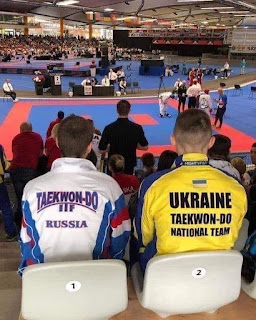
Russian and Ukrainian "brothers in Taekwon-Do"
sitting beside each other at a Taekwon-Do championships.
(Reposted from Facebook. Original source unknown.)

Taekwon-Do vis-à-vis the Russian Invasion of Ukraine

Dr. Sanko Lewis


I’ve been seeing lots of posts on Facebook from the international Taekwon-Do community and specifically from the ITF Taekwon-Do community calling to ban Russian Taekwon-Do athletes from competing at international ITF Taekwon-Do events because of Russia’s invasion of Ukraine. In this post I want to outline why I disagree with this. However, before anybody accuse me of being pro-Russia or anti-Ukraine, let me make it clear: I am against the invasion of Ukraine by Russia and am against this war. A substantial part of my PhD dissertation[1] was about Ethics of War. There is much one can write about that topic but suffice it to say that I resonate with the Taoists on this topic—all wars are tragedies, all wars are lamentable.[2]


To return to the main topic of this essay, I do not agree with the banning of Russian Taekwon-Doin from international Taekwon-Do events.


First, Taekwon-Do has a history of being used for peace building and soft power diplomacy, by bringing together otherwise apathetic and even antagonistic groups under the banner of Taekwon-Do.[3] Soft power diplomacy uses non-coercive methods such as cultural exchange, sport events, positive media exposure, and so on, to affect positive relations through appeal and attraction. The first soft power diplomacy that Taekwon-Do was engaged in was already in 1959, when Choi Hong Hi, a general in the Republic of Korea (South Korea) military took a Taekwon-Do demonstration team on what was called a “Goodwill Tour”. Many of Taekwon-Do’s most famous grandmasters such as Nam Tae Hi, Kim Bok Man, Han Cha Kyo, and so on were part of that first international trip to Vietnam and Taiwan. Another Goodwill Tour in 1965 travelled to West Germany, Italy, Egypt, Turkey, Malaysia, and Singapore. In 1973, the ITF Demonstration Team toured 23 countries, including Eastern Bloc countries such as Poland, Hungary, and Yugoslavia. Such tours not only put South Korea in a positive light abroad, but it also helped to “bridge gaps between political ideologies”[4]. It was with this attitude that General Choi introduced Taekwon-Do to his former enemies: Japan (the former colonizers of Korea) and North Korea (whom he fought against during the Korean War). In fact, one of Choi’s proudest moments were the first time he saw Japanese Taekwon-Do athletes competing with Korean Taekwon-Do athletes at a Taekwon-Do World Championship. Furthermore, it was his lifelong dream that North and South Korea would reunify and that Taekwon-Do may play a part in that. Taekwon-Do has now been affective in bringing South and North Korea together on several significant occasions.


Rather than use Taekwon-Do to drive people apart, I think Taekwon-Do should be used to bring ‘opponents’ together. The most famous use of sport diplomacy (which is a form of soft power diplomacy) was in 1971, affectionately referred to as ‘Ping-pong diplomacy’, when table tennis was used to bring the antagonistic Unites States of America and People’s Republic of China together. This event paved the way for President Nixon to visit Beijing in 1972. Similarly, very high tensions between North and South Korea and North Korean and the United States were eased through Taekwon-Do diplomacy, when North Korean and South Korean Taekwon-Do demonstration teams came together to share the same stage during the 2018 PyeongChang Winter Olympic Games. These shared Taekwon-Do activities by North and South Koreans led to summits between North Korean leader Kim Jung Un and South Korean president Moon Jae In, and it is believed that this is what later led to the summits between Pyeongyang and Washington.


What we need to see is Ukrainian and Russian Taekwon-Do practitioners standing side by side and competing alongside each other as part of one global Taekwon-Do family. This is how, I believe, Taekwon-Do organizations should affect positive change towards peace. Taekwon-Do organizations should create opportunities for Ukrainian and Russian Taekwon-Do practitioners to shake hands with each other in friendship, to bow to each other in respect, and maybe even to hug each other in Taekwon-Do fraternity. Getting Russians and Ukrainians (and the rest of the world) to see each other’s common humanity should be the goal. Sharing photos of such moments of friendship and mutual respect between supposed enemies should be the publicity Taekwon-Do organizations should strive for—not virtue signaling through calls of bans, othering, and separation.   


Second, we ought to be very clear what we hope to achieve with sanctions. The idea that sanctions against Russian Taekwon-Do athletes will send some type of message to Vladimir Putin is, frankly, silly. Broad sanctions against groups of people—in an effort to somehow punish their leaders or in a hope that it would result in an internal overthrow of the government—are not particularly effective. For example, the USA has had sanctions against Cuba and North Korea for decades. This has done practically nothing to change the status quo in those countries. Rather, it just hurt the average Cuban and North Korean, and especially the poorest and weakest among them, while the elites continue to live in relative comfort while remaining in positions of power. Unless the sanctions are specific in nature, to target particular individuals and systems, they do not generally result in change. By banning all Russian Taekwon-Do athletes we are indirectly signaling that all Russians are evil, and not affecting the power structure. Rather, I am in support of World Taekwondo for stripping President Putin of the honorary black belt they bestowed upon him in 2013[5]; and the protests calling for Yongin University (South Korea) to recall the Honorary Doctorate Degree in Judo Studies that they bestowed upon Putin in 2010[6]. These are focused signals of disapproval against the guilty, without scapegoating a whole nation.


Third, I think it is hypocritical of the international ITF community to discriminate against Russia, but not against other aggressive or oppressive countries. Consider, for instance, the invasions and attacks by foreign forces of Iraq, Afghanistan, Syria, Yemen, Libya, Pakistan, Algeria, Mali, Senegal, Tunisia, Kyrgyzstan, and the list goes on. The United States of America, the United Kingdom, and several other Western countries, as well as the United Arab Emirates, have attacked or invaded the list of countries above over the last several decades. To this day, there are still American and other forces in places like Iraq and Yemen. It is a well-established fact that the war on Iraq (that began under the Bush administration) was not a justifiable invasion[7], but based on the lie of “weapons of mass destruction” and was more likely motivated by wanting an access to Iraqi resources. Invading forces in Yemen include Saudi Arabia and the United States (which started under the Obama administration). The current famine in Yemen, which is directly related to the wars in the country, is considered the worse famine in the world in the last century[8]. Yet, the international Taekwon-Do community is not calling for the ban on Taekwon-Do athletes from the United States, the United Kingdom, Saudi Arabia, or any other Western country involved in such foreign invasions. Similarly, it generally accepted by the international community that the Chinese government is violating the human rights of the Uyghurs and other Turkic Muslims in the Xinjiang regions[9]—not to mention China’s oppression of freedoms in Tibet and Hong Kong. Yet, the international Taekwon-Do community is not calling for the ban of Taekwon-Do athletes from China. Without consistency, banning members from one aggressive country but not another is hypocritical and void of integrity (a supposed fundamental tenet in Taekwon-Do).


My hope that Taekwon-Do may be used to create spaces that are welcoming to anyone “regardless of religion, race or ideology” may be naïve. Still, it is this “Philosophy of Taekwon-Do”[10] that I am advocating. If Taekwon-Do is to be used politically, let it be in peace building efforts that create unity, not separation. Let Taekwon-Do transcend the “Us vs. Them”-narrative, and instead let Taekwon-Do frame a space for the pursuit of peace—an extended “Do-Jang”—where Ukrainian, Russian, and other Taekwon-Doin from around the world can come together as a “We” around our common goals to be champions of “freedom and justice” and to “build a more peaceful world.”[11]


[1] Lewis, S. 2016. Promoting Peace, Practising War: Mohism’s Resolution of the Paradoxical Ethics of War and Self-Defence in East Asian Martial Arts. (PhD Thesis. Department of Sport & Taekwondo, Graduate School of Physical Education of Kyunghee University, Korea.)

[2] Lao Tzu, Daodejing, Chapter 31: “There is no glory in victory [ . . . ] When victorious in war, one should observe the rites of mourning.” (Lau, D. C., trans. (1963). Lao Tzu: Tao Te Ching. Harmondsworth: Penguin Books.)

[3] Johnson, J. A. & Vitale, G. 2018. “Taekwondo Diplomacy: New Possibilities for Peace on the Korean Peninsula.” Physical Activity Review, 6: 237-250.

[4] Vitale, G. 2022. “A History of TaeKwon-Do Demo’s.” Totally Tae Kwon Do. Republished March 2022. (Originally published July 2009.)

[5] “World Taekwondo revokes Putin’s honorary black belt over Ukraine.” Korea Times. 1 March 2022. URL: https://www.koreatimes.co.kr/www/sports/2022/03/600_324757.html

[6] “Calls grow for revocation of Putin’s honorary degree at Yong In University.” The Korea Herald. 27 February 2022. URL: http://www.koreaherald.com/view.php?ud=20220227000199

[7] Fisher, D & Biggar, N. 2011. “Was Iraq an unjust war? A debate on the Iraq war and reflections on Libya.” International Affairs, 87(3): 687-707.

[8] “Yemen could be ‘worst famine in 100 years’”. BBC. 15 October 2018. URL: https://www.bbc.com/news/av/world-middle-east-45857729

[9] “China: ongoing Human rights violations against Uyghurs and other Turkic Muslims in Xinjiang.” International Federation for Human Rights. 28 June 2021. URL: https://www.fidh.org/en/region/asia/china/china-ongoing-human-rights-violations-against-uyghurs-and-other

[10] Choi, H. H. “Philosophy of Taekwon-Do.” ITF Taekwon-Do Encyclopedia. Vol. 1.

[11] Choi, H. H. “Oath of Taekwon-Do.” ITF Taekwon-Do Encyclopedia. Vol. 1.

20 July 2020

Problems with Using Taekwondo as a Sport for Peace Promotion

In 2017 at the 6th International Symposium for Taekwondo Studies, hosted at the Taekwondowon in Muju, South Korea, I gave a presentation titled: "Problems with Using Taekwondo as a Sport for Peace Promotion." Originally, the idea was to develop the presentation into a paper for publication, but I never got around to it. In the meantime, sections from the presentation was developed into a different paper which was recently published. I've received several requests for this text of that 2018 presentation paper and since it has not been published--and probably will not be published in its current form--I decided to upload it here. It is a bit more academic than my usual posts here on my blog, but hopefully it will be useful to some people. This post also provides a locale for citation purposes. However, please note that this blog does not purport to be an academic resource. I usually use this as a space to brainstorm and share thoughts and ideas as there are still developing. Thus, the material I post here are usually pre-academic publication, and therefor not yet peer reviewed.

Problems with Using Taekwondo as a Sport for Peace Promotion


by Sanko Lewis, PhD.

Abstract


Taekwondo organisations such as the World Taekwondo Federation has made it a goal to use Taekwondo for peace promotion, which is in line with the moral goals of the early pioneers of this martial art; however, there is an intrinsic dissonance between the aim of peace and the violent techniques that are innate to Taekwondo. To overcome this dissonance, there has been a shift in focus towards the sport aspect of Taekwondo. By re-branding Taekwondo as primarily a sport, rather than a martial art, the focus is shifted from violent “martial” techniques, to simply sport competition. In so doing, the peace promotion goal can be accomplished through sport diplomacy, which is a type of soft diplomacy. However, a shift away from martial art to combat sport is problematic: most practitioners continue to view Taekwondo as a martial art, not simply a sport; a sport focus reduces the technical arsenal of the martial art to only those techniques appropriate for the competition context; there is also a loss of philosophical and cultural heritage when a martial art becomes a sport, which is then replaced by new Western sport ideals. The latter may be interpreted as a type of “soft colonialism” with the original Oriental heritage being replaced by Western ideas of sport. Although the aim of using Taekwondo for soft diplomacy is commendable, a sport focus may not be the best course for achieving Taekwondo’s peace promotion goal. Further thinking is necessary to find other means to achieve this peace promotion ideal.

Keywords: peace promotion, soft power diplomacy, sports diplomacy, cultural heritage, martial art, combat sport, taekwondo

Introduction


The Korean 'Unification Flag'
There are several international entities that govern what is commonly referred to as Taekwondo. For example, Word Taekwondo (WT), previously known as 'World Taekwondo Federation', focusses on the competitive aspect of Taekwondo, while the Kukkiwon is more concerned with the technical and educational foundation of Taekwondo. These organizations have put forth a goal of peace promotion through Taekwondo. WT, especially, has of late emphasized this goal. On 9 May 2015, at the 5th International Symposium for Taekwondo Studies the WT president said the following during the opening address: “Taekwondo is a combat sports, as you all know, a martial art sports, but Taekwondo is the only martial arts sports, supporting sports through world peace” (3). WT established the World Taekwondo Peace Corps Foundation already in 2009 and the following year it was showcased at the UN-IOC Sport for Development and Peace Conference in Geneva. Using sports as a means of peace promotion is a well-established method for “soft power” diplomacy. The famous example of sport diplomacy was the so-called “ping-pong diplomacy” used in the 1970s to open dialogue between an otherwise antagonistic United States and China. Another famous example of using sport for peace promotion was when Nelson Mandela used rugby as a means of bringing the racially divided South Africans together when the country hosted the 1995 Rugby World Cup. Sport events have also been used to build connections between North and South Korea, for example at the 2000 Summer Olympics and several subsequent sporting events where the two countries shared a single flag (“Korea Unification Flag”). Sport diplomacy is indeed an admirable and possibly useful method for peace promotion. However, there are certain problems with attempts at using Taekwondo for this purpose.

This paper will highlight some of the problems with this sport emphasis towards achieving Taekwondo’s peace promotion goal.

First, a quick historic overview of Taekwondo and its peace promotion goal will be provided. Then, several problems with this goal will be pointed out. Firstly, there is an intrinsic issue with Taekwondo being a system of violent techniques used to promote peace. The solution to this problem is to suggest that Taekwondo should not be viewed as truly a martial art (i.e. fighting system), but that it should rather be reinterpreted as a combat sport. This view is problematic for several reasons, which will be addressed. It is important for organizations such as WT that wants to use Taekwondo as a political peace promotion tool to first address these issues.

Taekwondo’s Peace Teaching: An Overview


Taekwondo developed from nine Kwan (gyms) in South Korea in the late 1940s and 1950. From early on some of these Kwan taught ideals of peace promotion.  From writings dating to 1957 by Park Chul Hee who was co-founder of the Kung Duk Kwan, we learn that the Taekwondo students were “to make contribution to the world peace and prosperity of civilization” (sic) (8). Choi Hong Hi, founder of the Oh Do Kwan, wrote in 1965 that Taekwondo should not be used to start fights, but instead be used “to help the weak” (2). To be proponents of peace were stressed in Choi’s later writings as well. Practitioners should “never misuse Taekwondo”, but instead should be “gentle to the weak and tough to the strong” and aim to be champions “of freedom and justice” that strive to “build a more peace world” (1).  The Chung Do Kwan’s 1968 Taekwondo Manual also affirmed that Taekwondo practitioners should not initiate fights with others, that they should never make the first move in a fight. Rather, Taekwondo practitioners should “love peace, [and] protect justice and humanitarianism” (8). Rhee Ki Ha, one of the early promoters of Taekwondo outside of Korea describes Taekwondo as “the physical, spiritual and mental practice of human rights and human equality” (10).

Apart from such teachings, Taekwondo has also been used as soft power diplomacy since very early on. Already in 1959 a Taekwondo military team from South Korea toured Vietnam and China for intercultural exchange between these countries (7). This was only the first of many future “goodwill tours.” In 1965 a “Kukki Taekwon-Do Goodwill Demonstration Team” visited Egypt, Germany, Italy, Malaysia, Singapore, and Turkey (7). Such cultural exchange using Taekwondo was not only used by South Korea, but North Korea has benefited from using Taekwondo in this way as well. The two Koreas have had Taekwondo exchanges since 2002 when a South Korean team visited North Korea, to be followed shortly thereafter by a team from the north visiting the South. A similar exchanged happened in 2007 when a North Korean Taekwondo demonstration team visited Seoul and Chuncheon. The two countries also took hands in 2015 at the WT Taekwondo Championships in Chelyabinsk, Russia, when demonstration teams from North Korea and South Korea shared the stage during the opening ceremony.

ITF and WT demonstration teams sharing a stage under the slogan "Peace is more precious than Triumph".


With peace teachings being part of Taekwondo, and the precedent of using Taekwondo for soft power diplomacy well established, what could be wrong with using Taekwondo in this manner? The next section will expound on this.


The Martial Art as Sport Approach


In a discussion of modern Taekwondo trends, Taekwondo sociologist Udo Mönig notes the often used “slogan of promoting ‘peace through taekwondo’” (9). Using “an aggressive martial art” for peace promotion is “awkward,” says Mönig (9). Attempts at using martial arts (i.e. fighting systems) for peace promotion seems antithetical—causing an intuitive dissonance. We can infer a similar dissonance from WT President Choue as well, when he pointed out that Taekwondo is a “combat sport” on the one hand, but that it is used for promoting “world peace” on the other hand (3). That he needs to emphasise the odd bringing together of war techniques for peace promotion reveals the innate dissonance of this endeavour.

Aikido is another martial art that emphasizes peace promotion. What makes Aikido different from Taekwondo in this regard is Aikido’s removal of nearly all offensive techniques. Aikido doesn’t actively teach kicks or strikes, nor hard blocks that can be used as offensive-defence. Rather, Aikido’s goal is the use of techniques that blend with the opponent’s force and redirect or lessen the opponent’s aggression. Aikido strategy often includes control-techniques aimed at immobilizing the opponent to prevent an escalation of “fighting” and violence. While the practical effectiveness of Aikido may be questioned by some, at least there is harmony between Aikido’s peace teachings and its physical practice that encourages harmoniously moving with the opponent to dissuade the violent energy. On the other hand, a kicking and striking art like Taekwondo have a discord between its aggressive techniques and its peace teachings.

To resolve the dissonance of using an aggressive martial art for peace promotion, WT and several scholars have claimed that Taekwondo must be understood not as a martial art (i.e. a system based on fighting techniques), but rather as a sport. Indeed, some scholars such as Mönig are arguing for the full metamorphosis of Taekwondo from a martial art with roots in military practice, to a pure sport stripped of all its historic martial arts baggage (9). Such an evolution of Taekwondo from combat system to sport would align Taekwondo with the goal of the Olympic Games, which is to “place sport at the service of harmonious development of humankind, with a view to promoting a peaceful society concerned with the preservation of human dignity” and “to place sport at the service of humanity and thereby to promote peace” (6).

Is Taekwondo simply a sport?
The argument in favour of changing Taekwondo from martial art to sport is based on the notion that in “modern civil societies . . . martial arts have no purpose for real fighting” (9). In other words, Taekwondo’s function as a martial art used for fighting (either in military contexts or personal self-defence) has become obsolete because of the civility of modern societies. This is, however, a privileged interpretation by people fortunate enough to live in such “modern civil societies.” While martial arts may not be of much value in modern military combat, the value of martial arts as self-defence systems for people living in both first and third world societies are still of great value. In fact, a primary reason for a large percentage of people taking up martial arts continues to be the self-defence value of martial arts. Official attempts by Taekwondo organizations to brand Taekwondo as a combat sport, rather than a martial art, is doing so contrary to the millions of instructors and practitioners around the world for whom Taekwondo is more than just a combat sport, the likes of, say, western boxing.

The Unfortunate Cost of Evolving from Martial Art to Combat Sport


Furthermore, an evolution from martial art to combat sport comes at an unfortunate cost.

First, when a martial art changes into a sport there is a dilution of the rich historical arsenal of the original system. When Judo was developed as a streamlined version of Jujutsu, many of the original techniques were purged. Similarly, when the focus in Taekwondo becomes sport competition, a big percentage of techniques are inevitably neglected. Taekwondo enthusiasts are all aware how Olympic Taekwondo has reduced the martial art—that is by its very name supposed to be a foot-and-hand system—into primarily a kicking system. Sadly, an emphasis on kicking in sport Taekwondo has not enriched Taekwondo’s kicking arsenal with more kicks, but rather reduced the arsenal to only a handful of techniques that works well in the limited context of the sports ring.

Second, not only are there technical losses when a martial art becomes a sport, but there is also an intangible loss in the form of a reduced cultural and philosophical heritage. Of the surviving historic European martial arts (HEMA) that became modern sports such as western boxing, Greco-Roman wrestling, and fencing, very little of the original cultural and philosophical heritage are practised and celebrated by the athletes practising these sports. Even Judo, which was intended by its founder to be a pedagogic tool to teach certain philosophical values, is in current times usually practised simply as a sport with hardly any philosophical teachings as part of training. Contrary to such combat sports, in martial arts the cultural and philosophical heritages are usually integral to their practise.

Olympism is based on Grecian (i.e. Western) philosophical ideas.

Third, when the philosophical and cultural heritage is removed it is often replaced with “[p]ositive sporting values and objectives” (9). In the case of Taekwondo as promoted by WT, an emphasis is given to the sport values of Olympism. This means that the original East Asian philosophy and values that are inherent to the martial arts are replaced with western values (i.e. Grecian inspired Olympism) for the combat sport. The adoption of Olympism may at first seem commendable. However, the East Asian martial arts are not culturally neutral. Quite the opposite: East Asian martial arts, like folk dances, function as containers of cultural heritage. Therefore, when focussing on the sport aspect of the martial art there is an emphasis on the new sport values, which inevitably results in a de-emphasis of the original cultural heritage. In a discussion on the western-centric Olympic sports, Allen Guttmann laments the resultant cultural imperialism (5). He argues that even when East Asian martial arts spread to the west, they often “[transformed] in accordance with Western assumptions about the nature of sports” (5). Ironically, instead of the intended goal of using Taekwondo for soft power diplomacy, the result is a form of “soft colonialism,” where the original martial art loses its Oriental identity—to be replaced with a western inspired identity. At the very least this should be considered culturally insensitive and a regrettable loss.

Finally, even if Taekwondo were to fully evolve from martial art to simply a combative sport, it doesn’t solve the original “awkward” issue of using combat (i.e. fighting) for peace promotion. The use of combat sport to bring people together is much too reminiscent of gladiator matches or monomachy used to settle disputes. Endorsing the use of violence to create unity is hardly a message that Taekwondo authorities should wish to promulgate.

Conclusion


The goal of using a martial art, with its violent techniques, for peace promotion is intrinsically “awkward” (9). To overcome this awkwardness there has been an effort to reinterpret the function of Taekwondo. Instead of viewing Taekwondo as a martial art with roots in military combat, Taekwondo is to be viewed as a combat sport. This evolution away from “martial” to “sport” is an attempt to remove the innately violent aspect of the martial art. If Taekwondo can be viewed as primarily a sport, then its violent aspects can be downplayed as simply sport competition. As merely a sport, Taekwondo can be used as a tool for soft power diplomacy (i.e. sports diplomacy). Unfortunately, the change from martial art to combat sport presents other problems and regrettable losses of both techniques and cultural heritage.

The goal of employing Taekwondo as a peace promotion tool is an admirable endeavour and clearly in harmony with the intention of the early Taekwondo pioneers. However, there is a difference between how the early pioneers viewed peace promotion and how such peace promotion is attempted by the current Taekwondo organizations such as World Taekwondo. From the writings of the early pioneers we notice that their peace promotion ideal was not separate from the combative function of the martial arts. Although they encouraged members not to be the instigators of violence and not to misuse Taekwondo, they did not try to remove the possibility of violent (re-)action. Practitioners were encouraged to protect the weak from the strong and to fight for freedom and justice—this may involve literal, physical fighting and cannot be understood only as figurative fighting. Their writings clearly imply that the use of Taekwondo’s violent combative techniques are to be used if necessary. Current attempts at de-emphasizing the violent side of Taekwondo and emphasizing Taekwondo as a peace promoting sport is at odds with Taekwondo’s historic development as a “Killing Art” and intrinsic function as “Korea’s Art of Self-Defence” (4, 1). What the pioneers had in mind was less political, in the form of soft power diplomacy, and more practical forms of empowerment. The practise of Taekwondo strengthens both body and mind and thereby empowers practitioners to stand-up for themselves and stand-up for others.

The current approach of envisioning Taekwondo as a sport to be used for sport diplomacy is praiseworthy, but it is the author’s opinion that this is ultimately not the best way to ensure Taekwondo’s peace promotion ideals. Instead, a way to harmonise Taekwondo’s innate “martial” nature with its peace promotion ideal should be sought. One path suggested is to emphasize the empowering nature of the martial arts. Further research into reconciling the martial arts and peace promotion ideals is necessary.

References


  1. Choi, H. H. Encyclopedia of Taekwondo. 5th ed. Canada: International Taekwon-Do Federation; 1999.
  2. Choi, H. H. Tae Kwon Do. 2nd printing. Los Angeles: Masters Publication; 2007.
  3. Choue, C. W. The 5th International Symposium for Taekwondo Studies – Dr Chungwon Choue Opening Address [Internet]. 2015. [cited 2016 November 25]. World Taekwondo Federation – YouTube Channel. Available from: https://www.youtube.com/watch?v=UxE7be83wAY
  4. Gillis, A. A Killing Art: The Untold History of Tae Kwon Do. 2nd ed. Toronto: ECW Press; 2016.
  5. Guttmann, A. The diffusion of sports and the problem of cultural imperialism. The Sports Process. 1993. p. 125-137.
  6. International Olympic Committee. Olympic Charter. Lausanne: IOC; 2015.
  7. Kimm, H.Y. Taekwondo History. Baton Rouge, LA.: Hando Press; 2013.
  8. Kukkiwon. Taekwondo Leadership Training Manual – 1st Class. Seoul; c2014. 364 p.
  9. Mönig, U. The Incomplete Transformation of Taekwondo from a 'Martial Art' to a 'Martial Sport'. Doctoral Dissertation. Department of Physical Education, Graduate School of Keimyung University; 2012.
  10. Rhee, K. H. This Is Taekwon-Do. UK: Media Insights; 2012.
  11. World Taekwondo Federation [Internet]. Taekwondo Peace Corps; n.d.; c2015. [cited 2015 Oct 4, 2015]. Available from http://www.worldtaekwondofederation.net/taekwondo-peace-corps