Showing posts with label WTF. Show all posts

20 July 2020

Problems with Using Taekwondo as a Sport for Peace Promotion

In 2017 at the 6th International Symposium for Taekwondo Studies, hosted at the Taekwondowon in Muju, South Korea, I gave a presentation titled: "Problems with Using Taekwondo as a Sport for Peace Promotion." Originally, the idea was to develop the presentation into a paper for publication, but I never got around to it. In the meantime, sections from the presentation was developed into a different paper which was recently published. I've received several requests for this text of that 2018 presentation paper and since it has not been published--and probably will not be published in its current form--I decided to upload it here. It is a bit more academic than my usual posts here on my blog, but hopefully it will be useful to some people. This post also provides a locale for citation purposes. However, please note that this blog does not purport to be an academic resource. I usually use this as a space to brainstorm and share thoughts and ideas as there are still developing. Thus, the material I post here are usually pre-academic publication, and therefor not yet peer reviewed.

Problems with Using Taekwondo as a Sport for Peace Promotion


by Sanko Lewis, PhD.

Abstract


Taekwondo organisations such as the World Taekwondo Federation has made it a goal to use Taekwondo for peace promotion, which is in line with the moral goals of the early pioneers of this martial art; however, there is an intrinsic dissonance between the aim of peace and the violent techniques that are innate to Taekwondo. To overcome this dissonance, there has been a shift in focus towards the sport aspect of Taekwondo. By re-branding Taekwondo as primarily a sport, rather than a martial art, the focus is shifted from violent “martial” techniques, to simply sport competition. In so doing, the peace promotion goal can be accomplished through sport diplomacy, which is a type of soft diplomacy. However, a shift away from martial art to combat sport is problematic: most practitioners continue to view Taekwondo as a martial art, not simply a sport; a sport focus reduces the technical arsenal of the martial art to only those techniques appropriate for the competition context; there is also a loss of philosophical and cultural heritage when a martial art becomes a sport, which is then replaced by new Western sport ideals. The latter may be interpreted as a type of “soft colonialism” with the original Oriental heritage being replaced by Western ideas of sport. Although the aim of using Taekwondo for soft diplomacy is commendable, a sport focus may not be the best course for achieving Taekwondo’s peace promotion goal. Further thinking is necessary to find other means to achieve this peace promotion ideal.

Keywords: peace promotion, soft power diplomacy, sports diplomacy, cultural heritage, martial art, combat sport, taekwondo

Introduction


The Korean 'Unification Flag'
There are several international entities that govern what is commonly referred to as Taekwondo. For example, Word Taekwondo (WT), previously known as 'World Taekwondo Federation', focusses on the competitive aspect of Taekwondo, while the Kukkiwon is more concerned with the technical and educational foundation of Taekwondo. These organizations have put forth a goal of peace promotion through Taekwondo. WT, especially, has of late emphasized this goal. On 9 May 2015, at the 5th International Symposium for Taekwondo Studies the WT president said the following during the opening address: “Taekwondo is a combat sports, as you all know, a martial art sports, but Taekwondo is the only martial arts sports, supporting sports through world peace” (3). WT established the World Taekwondo Peace Corps Foundation already in 2009 and the following year it was showcased at the UN-IOC Sport for Development and Peace Conference in Geneva. Using sports as a means of peace promotion is a well-established method for “soft power” diplomacy. The famous example of sport diplomacy was the so-called “ping-pong diplomacy” used in the 1970s to open dialogue between an otherwise antagonistic United States and China. Another famous example of using sport for peace promotion was when Nelson Mandela used rugby as a means of bringing the racially divided South Africans together when the country hosted the 1995 Rugby World Cup. Sport events have also been used to build connections between North and South Korea, for example at the 2000 Summer Olympics and several subsequent sporting events where the two countries shared a single flag (“Korea Unification Flag”). Sport diplomacy is indeed an admirable and possibly useful method for peace promotion. However, there are certain problems with attempts at using Taekwondo for this purpose.

This paper will highlight some of the problems with this sport emphasis towards achieving Taekwondo’s peace promotion goal.

First, a quick historic overview of Taekwondo and its peace promotion goal will be provided. Then, several problems with this goal will be pointed out. Firstly, there is an intrinsic issue with Taekwondo being a system of violent techniques used to promote peace. The solution to this problem is to suggest that Taekwondo should not be viewed as truly a martial art (i.e. fighting system), but that it should rather be reinterpreted as a combat sport. This view is problematic for several reasons, which will be addressed. It is important for organizations such as WT that wants to use Taekwondo as a political peace promotion tool to first address these issues.

Taekwondo’s Peace Teaching: An Overview


Taekwondo developed from nine Kwan (gyms) in South Korea in the late 1940s and 1950. From early on some of these Kwan taught ideals of peace promotion.  From writings dating to 1957 by Park Chul Hee who was co-founder of the Kung Duk Kwan, we learn that the Taekwondo students were “to make contribution to the world peace and prosperity of civilization” (sic) (8). Choi Hong Hi, founder of the Oh Do Kwan, wrote in 1965 that Taekwondo should not be used to start fights, but instead be used “to help the weak” (2). To be proponents of peace were stressed in Choi’s later writings as well. Practitioners should “never misuse Taekwondo”, but instead should be “gentle to the weak and tough to the strong” and aim to be champions “of freedom and justice” that strive to “build a more peace world” (1).  The Chung Do Kwan’s 1968 Taekwondo Manual also affirmed that Taekwondo practitioners should not initiate fights with others, that they should never make the first move in a fight. Rather, Taekwondo practitioners should “love peace, [and] protect justice and humanitarianism” (8). Rhee Ki Ha, one of the early promoters of Taekwondo outside of Korea describes Taekwondo as “the physical, spiritual and mental practice of human rights and human equality” (10).

Apart from such teachings, Taekwondo has also been used as soft power diplomacy since very early on. Already in 1959 a Taekwondo military team from South Korea toured Vietnam and China for intercultural exchange between these countries (7). This was only the first of many future “goodwill tours.” In 1965 a “Kukki Taekwon-Do Goodwill Demonstration Team” visited Egypt, Germany, Italy, Malaysia, Singapore, and Turkey (7). Such cultural exchange using Taekwondo was not only used by South Korea, but North Korea has benefited from using Taekwondo in this way as well. The two Koreas have had Taekwondo exchanges since 2002 when a South Korean team visited North Korea, to be followed shortly thereafter by a team from the north visiting the South. A similar exchanged happened in 2007 when a North Korean Taekwondo demonstration team visited Seoul and Chuncheon. The two countries also took hands in 2015 at the WT Taekwondo Championships in Chelyabinsk, Russia, when demonstration teams from North Korea and South Korea shared the stage during the opening ceremony.

ITF and WT demonstration teams sharing a stage under the slogan "Peace is more precious than Triumph".


With peace teachings being part of Taekwondo, and the precedent of using Taekwondo for soft power diplomacy well established, what could be wrong with using Taekwondo in this manner? The next section will expound on this.


The Martial Art as Sport Approach


In a discussion of modern Taekwondo trends, Taekwondo sociologist Udo Mönig notes the often used “slogan of promoting ‘peace through taekwondo’” (9). Using “an aggressive martial art” for peace promotion is “awkward,” says Mönig (9). Attempts at using martial arts (i.e. fighting systems) for peace promotion seems antithetical—causing an intuitive dissonance. We can infer a similar dissonance from WT President Choue as well, when he pointed out that Taekwondo is a “combat sport” on the one hand, but that it is used for promoting “world peace” on the other hand (3). That he needs to emphasise the odd bringing together of war techniques for peace promotion reveals the innate dissonance of this endeavour.

Aikido is another martial art that emphasizes peace promotion. What makes Aikido different from Taekwondo in this regard is Aikido’s removal of nearly all offensive techniques. Aikido doesn’t actively teach kicks or strikes, nor hard blocks that can be used as offensive-defence. Rather, Aikido’s goal is the use of techniques that blend with the opponent’s force and redirect or lessen the opponent’s aggression. Aikido strategy often includes control-techniques aimed at immobilizing the opponent to prevent an escalation of “fighting” and violence. While the practical effectiveness of Aikido may be questioned by some, at least there is harmony between Aikido’s peace teachings and its physical practice that encourages harmoniously moving with the opponent to dissuade the violent energy. On the other hand, a kicking and striking art like Taekwondo have a discord between its aggressive techniques and its peace teachings.

To resolve the dissonance of using an aggressive martial art for peace promotion, WT and several scholars have claimed that Taekwondo must be understood not as a martial art (i.e. a system based on fighting techniques), but rather as a sport. Indeed, some scholars such as Mönig are arguing for the full metamorphosis of Taekwondo from a martial art with roots in military practice, to a pure sport stripped of all its historic martial arts baggage (9). Such an evolution of Taekwondo from combat system to sport would align Taekwondo with the goal of the Olympic Games, which is to “place sport at the service of harmonious development of humankind, with a view to promoting a peaceful society concerned with the preservation of human dignity” and “to place sport at the service of humanity and thereby to promote peace” (6).

Is Taekwondo simply a sport?
The argument in favour of changing Taekwondo from martial art to sport is based on the notion that in “modern civil societies . . . martial arts have no purpose for real fighting” (9). In other words, Taekwondo’s function as a martial art used for fighting (either in military contexts or personal self-defence) has become obsolete because of the civility of modern societies. This is, however, a privileged interpretation by people fortunate enough to live in such “modern civil societies.” While martial arts may not be of much value in modern military combat, the value of martial arts as self-defence systems for people living in both first and third world societies are still of great value. In fact, a primary reason for a large percentage of people taking up martial arts continues to be the self-defence value of martial arts. Official attempts by Taekwondo organizations to brand Taekwondo as a combat sport, rather than a martial art, is doing so contrary to the millions of instructors and practitioners around the world for whom Taekwondo is more than just a combat sport, the likes of, say, western boxing.

The Unfortunate Cost of Evolving from Martial Art to Combat Sport


Furthermore, an evolution from martial art to combat sport comes at an unfortunate cost.

First, when a martial art changes into a sport there is a dilution of the rich historical arsenal of the original system. When Judo was developed as a streamlined version of Jujutsu, many of the original techniques were purged. Similarly, when the focus in Taekwondo becomes sport competition, a big percentage of techniques are inevitably neglected. Taekwondo enthusiasts are all aware how Olympic Taekwondo has reduced the martial art—that is by its very name supposed to be a foot-and-hand system—into primarily a kicking system. Sadly, an emphasis on kicking in sport Taekwondo has not enriched Taekwondo’s kicking arsenal with more kicks, but rather reduced the arsenal to only a handful of techniques that works well in the limited context of the sports ring.

Second, not only are there technical losses when a martial art becomes a sport, but there is also an intangible loss in the form of a reduced cultural and philosophical heritage. Of the surviving historic European martial arts (HEMA) that became modern sports such as western boxing, Greco-Roman wrestling, and fencing, very little of the original cultural and philosophical heritage are practised and celebrated by the athletes practising these sports. Even Judo, which was intended by its founder to be a pedagogic tool to teach certain philosophical values, is in current times usually practised simply as a sport with hardly any philosophical teachings as part of training. Contrary to such combat sports, in martial arts the cultural and philosophical heritages are usually integral to their practise.

Olympism is based on Grecian (i.e. Western) philosophical ideas.

Third, when the philosophical and cultural heritage is removed it is often replaced with “[p]ositive sporting values and objectives” (9). In the case of Taekwondo as promoted by WT, an emphasis is given to the sport values of Olympism. This means that the original East Asian philosophy and values that are inherent to the martial arts are replaced with western values (i.e. Grecian inspired Olympism) for the combat sport. The adoption of Olympism may at first seem commendable. However, the East Asian martial arts are not culturally neutral. Quite the opposite: East Asian martial arts, like folk dances, function as containers of cultural heritage. Therefore, when focussing on the sport aspect of the martial art there is an emphasis on the new sport values, which inevitably results in a de-emphasis of the original cultural heritage. In a discussion on the western-centric Olympic sports, Allen Guttmann laments the resultant cultural imperialism (5). He argues that even when East Asian martial arts spread to the west, they often “[transformed] in accordance with Western assumptions about the nature of sports” (5). Ironically, instead of the intended goal of using Taekwondo for soft power diplomacy, the result is a form of “soft colonialism,” where the original martial art loses its Oriental identity—to be replaced with a western inspired identity. At the very least this should be considered culturally insensitive and a regrettable loss.

Finally, even if Taekwondo were to fully evolve from martial art to simply a combative sport, it doesn’t solve the original “awkward” issue of using combat (i.e. fighting) for peace promotion. The use of combat sport to bring people together is much too reminiscent of gladiator matches or monomachy used to settle disputes. Endorsing the use of violence to create unity is hardly a message that Taekwondo authorities should wish to promulgate.

Conclusion


The goal of using a martial art, with its violent techniques, for peace promotion is intrinsically “awkward” (9). To overcome this awkwardness there has been an effort to reinterpret the function of Taekwondo. Instead of viewing Taekwondo as a martial art with roots in military combat, Taekwondo is to be viewed as a combat sport. This evolution away from “martial” to “sport” is an attempt to remove the innately violent aspect of the martial art. If Taekwondo can be viewed as primarily a sport, then its violent aspects can be downplayed as simply sport competition. As merely a sport, Taekwondo can be used as a tool for soft power diplomacy (i.e. sports diplomacy). Unfortunately, the change from martial art to combat sport presents other problems and regrettable losses of both techniques and cultural heritage.

The goal of employing Taekwondo as a peace promotion tool is an admirable endeavour and clearly in harmony with the intention of the early Taekwondo pioneers. However, there is a difference between how the early pioneers viewed peace promotion and how such peace promotion is attempted by the current Taekwondo organizations such as World Taekwondo. From the writings of the early pioneers we notice that their peace promotion ideal was not separate from the combative function of the martial arts. Although they encouraged members not to be the instigators of violence and not to misuse Taekwondo, they did not try to remove the possibility of violent (re-)action. Practitioners were encouraged to protect the weak from the strong and to fight for freedom and justice—this may involve literal, physical fighting and cannot be understood only as figurative fighting. Their writings clearly imply that the use of Taekwondo’s violent combative techniques are to be used if necessary. Current attempts at de-emphasizing the violent side of Taekwondo and emphasizing Taekwondo as a peace promoting sport is at odds with Taekwondo’s historic development as a “Killing Art” and intrinsic function as “Korea’s Art of Self-Defence” (4, 1). What the pioneers had in mind was less political, in the form of soft power diplomacy, and more practical forms of empowerment. The practise of Taekwondo strengthens both body and mind and thereby empowers practitioners to stand-up for themselves and stand-up for others.

The current approach of envisioning Taekwondo as a sport to be used for sport diplomacy is praiseworthy, but it is the author’s opinion that this is ultimately not the best way to ensure Taekwondo’s peace promotion ideals. Instead, a way to harmonise Taekwondo’s innate “martial” nature with its peace promotion ideal should be sought. One path suggested is to emphasize the empowering nature of the martial arts. Further research into reconciling the martial arts and peace promotion ideals is necessary.

References


  1. Choi, H. H. Encyclopedia of Taekwondo. 5th ed. Canada: International Taekwon-Do Federation; 1999.
  2. Choi, H. H. Tae Kwon Do. 2nd printing. Los Angeles: Masters Publication; 2007.
  3. Choue, C. W. The 5th International Symposium for Taekwondo Studies – Dr Chungwon Choue Opening Address [Internet]. 2015. [cited 2016 November 25]. World Taekwondo Federation – YouTube Channel. Available from: https://www.youtube.com/watch?v=UxE7be83wAY
  4. Gillis, A. A Killing Art: The Untold History of Tae Kwon Do. 2nd ed. Toronto: ECW Press; 2016.
  5. Guttmann, A. The diffusion of sports and the problem of cultural imperialism. The Sports Process. 1993. p. 125-137.
  6. International Olympic Committee. Olympic Charter. Lausanne: IOC; 2015.
  7. Kimm, H.Y. Taekwondo History. Baton Rouge, LA.: Hando Press; 2013.
  8. Kukkiwon. Taekwondo Leadership Training Manual – 1st Class. Seoul; c2014. 364 p.
  9. Mönig, U. The Incomplete Transformation of Taekwondo from a 'Martial Art' to a 'Martial Sport'. Doctoral Dissertation. Department of Physical Education, Graduate School of Keimyung University; 2012.
  10. Rhee, K. H. This Is Taekwon-Do. UK: Media Insights; 2012.
  11. World Taekwondo Federation [Internet]. Taekwondo Peace Corps; n.d.; c2015. [cited 2015 Oct 4, 2015]. Available from http://www.worldtaekwondofederation.net/taekwondo-peace-corps

06 November 2019

1st International Academic Taekwondo Conference Youngsan University

1st International Academic Taekwondo Conference
Youngsan University

On October 4th, 2019, Youngsan University hosted their 1st International Academic Taekwondo Conference at their Yangsan Campus (Ulsan, South Korea). I was invited to present a paper for this conference.

Dr Sanko Lewis presenting at the
1st International Academic Taekwondo Conference,
Youngsan University


I titled my presentation "From Individual Heroes to National Performers: The Shift in Taekwondo's Peace Promotion Duty". Following is the abstract:

The writings of several of the early taekwondo pioneers connect taekwondo practice with peace promotion. These pioneers charged taekwondo practitioners with a duty to contribute to justice, defend the weak, and build a more peaceful world. National and international taekwondo organizations such as the Kukkiwon, World Taekwondo, and the International Taekwon-Do Federation have taken up the charge of peace promotion through taekwondo by means of transnational events, such as goodwill tours and joined taekwondo demonstrations by adversarial states (e.g. North and South Korea). These activities may be described as soft diplomacy initiatives and have seen some level of success. While these soft diplomacy activities are in line with the goal of peace promotion that the early pioneers advocated, they are qualitatively different from what the pioneers advocated. Originally, the responsibility of peace promotion was on the individual taekwondo practitioner, who ought to cultivate moral character, courage, and martial art skill in order to standup for justice and defend the weak. With the current use of taekwondo for soft diplomacy, the responsibility of peace promotion has shifted from the individual practitioner to the corporate, i.e. the governing and national bodies. Instead of focusing on issues surrounding justice and the protection of the weak, these corporate bodies focus on geopolitical cooperation, mediated through cultural exchange activities in the form of taekwondo demonstrations, involving activities such as poomsae performances and board-breaking that require little actual courage or serious personal risk to the individual practitioners. The charge to safeguard justice and physically defend the weak, which are acts of true courage that may have serious personal risk, as was envisioned by the taekwondo pioneers, is mostly ignored.

The article still needs some work before I can submit it with an academic journal for publication.

The conference included two other well established taekwondo researchers, Dr. John Johnson who spoke on "Mudo within North Korean Taekwondo Pedagogy" and Dr. Steven Capener, who addressed "How Korea Created and then Destroyed the Martial Sport of Taekwondo". Dr. John Frankl and Dr Udo Moenig took part in the discussion session. Drs. Johnson, Capener, Moenig, and myself (Lewis), are the four non-Korean academics living in Korea, working at universities here, and doing research in Taekwondo. Dr Frankl's martial art focus is Brazilian Jiujitsu.

06 June 2019

The Unfortunate Cost of Evolving from Martial Art to Combat Sport

I've written long ago why I'm not fond of tournament sparring (1, 2). In short, if self-defence training is the goal, a focus on tournament sparring can hamper that goal because tournament sparring tends to narrow the scope of the training to the sporting arena context, which is far too artificial to reflect the reality of a self-defence encounter. Traditional martial arts, and in particular civilian defensive arts, envision quite a different context to prepare for than that of a competition ring.

However, in this post I want to speak about other "costs" that comes at the expense of a sport focus.

Here I want to focus on the WT style of Taekwon-Do as an Olympic sport. There are some attempts to get ITF Taekwon-Do to also join with WT to become one event alongside WT under the "Taekwondo" umbrella. There is a believe that such a move will secure the ITF Taekwon-Do's longevity, enhance its prestige, and strengthen Taekwon-Do's position at the Olympic Games.

Image Source: https://www.olympic.org/taekwondo


I am somewhat skeptical. I believe an evolution from martial art to combat sport comes at an unfortunate cost.

First, when a martial art changes into a sport there is a dilution of the rich historical arsenal of the original system. When Judo was developed as a streamlined version of Jujutsu, many of the original techniques were purged. Similarly, when the focus in Taekwondo becomes sport competition, a big percentage of techniques are inevitably neglected. Taekwondo enthusiasts are all aware how Olympic Taekwondo has reduced the martial art—that is by its very name supposed to be a foot-and-hand system—into primarily a kicking system. Sadly, an emphasis on kicking in sport Taekwondo has not enriched Taekwondo’s kicking arsenal with more kicks, but rather reduced the arsenal to only a handful of techniques that works well in the limited context of the sports ring.

Image Source: https://en.wikipedia.org/wiki/Greco-Roman_wrestling
Second, not only are there technical losses when a martial art becomes a sport, but there is also an intangible loss in the form of a reduced cultural and philosophical heritage. Of the surviving historic European martial arts (HEMA) that became modern sports such as western boxing, Greco-Roman wrestling, and fencing, very little of the original cultural and philosophical heritage are practised and celebrated by the athletes training and competing in these sports. Even Judo, which was intended by its founder to be a pedagogic tool to teach certain philosophical values, is in current times usually practised simply as a sport with hardly any philosophical teachings as part of training. Contrary to such combat sports, in martial arts the cultural and philosophical heritages are usually integral to their practise.

Third, when the philosophical and cultural heritage is removed it is often replaced with “[p]ositive sporting values and objectives”*. In the case of Taekwondo as promoted by the WT, an emphasis is given to the sport values of Olympism. This means that the original East Asian philosophy and values that are inherent to the martial arts are replaced with western values (i.e. Grecian inspired Olympism) for the combat sport. The adoption of Olympism may at first seem commendable. However, the East Asian martial arts are not culturally neutral. Quite the opposite: East Asian martial arts, like folk dances, function as containers of cultural heritage. Therefore, when focussing on the sport aspect of the martial art there is an emphasis of the new sport values, which inevitably results in a de-emphasis of the original cultural heritage. In a discussion on the western-centric Olympic sports, Allen Guttmann laments the resultant cultural imperialism. He argues that even when East Asian martial arts spread to the west, they often “[transformed] in accordance with Western assumptions about the nature of sports”*. Ironically, instead of the intended goal of using Taekwondo for soft power diplomacy the result is a form of “soft colonialism,” where the original martial art loses its Oriental identity—to be replaced with a western inspired identity. At the very least this should be considered culturally insensitive and a regrettable loss.

Is the security and prestige of joining the Olympic Games worth the losses? For some people who see the opportunity of winning a medal at the Olympic Games in their chosen sport, it is worth it. For others, those who see the martial arts something other than a sport, for example as containers of cultural heritage, it is not.

21 November 2018

"100th Anniversary of Choi Honghi: Taekwon-Do and Life; How to View Choi Honghi"


Over the weekend I had the opportunity to attend a symposium about General Choi 최홍희.

The symposium was in honour of the 100th Anniversary of the birth of General Choi, the “principle founder of original Taekwon-Do” (as Taekwon-Do historian Dr George Vitale likes to put it). General Choi’s claim to the title of “founder” of Taekwon-Do is not without controversy and while his great contribution to Taekwon-Do is undeniable (even so far as coining the term “TaeKwon-Do”), in South Korea his legacy has been nearly eradicated because of the conflict he had with the then dictator-president Park Chonghee. Gen. Choi’s later visit to the North further estranged him from South Korea.

The purpose of this symposium, organised by Taekwondo Box Media and hosted at the Korea National Sports University, was to re-asses General Choi’s contribution. The university president gave an opening remark, which was followed by the reading of a handwritten letter by General Choi’s wife.

A handwritten letter of appreciation from Mrs Choi,
the widow of Gen. Choi

There were two speakers. The first speaker was Dr. Heo Keon-sik (허건식), General Director of the Chungju World Martial Arts Masterships Organizing Committee. He discussed “The Martial Artist, Choi Hong-hee”. Dr Heo had an interesting approach. He looked at the founders of Judo (Kano), modern Karate (Funakushi), and Kyukushin Karate (Mas Oyama, aka 최영의) and noted how each of them studied a previous martial art and then changed it into something new. By comparison, he argued, that General Choi did the same within the Oh Do Kwan (which was the name of Gen. Choi’s karate school in the ROK military from which Taekwon-Do evolved). Dr Heo also differentiated between the “core” of ITF Taekwon-Do (i.e. Gen. Choi’s Taekwon-Do) and WT / Olympic Taekwondo. For him, the core of Olympic Taekwondo is sport competition, whereas in ITF it is traditional martial arts (if I understood him correctly). A point Dr Heo frequently brought up was “Red Complex”, which is a term used in Korea to refer to the overreaction of anything remotely related to North Korea or Communism. Because of General Choi and the ITF’s connection with North Korea, General Choi became a taboo topic and anything to do with him enticed “Red Complex”. Unfortunately, my understanding of the presentation was limited, so this is all I could derive from Dr. Heo’s presentation.

The second speaker was Dr. Mikhail Han (한병철), a martial arts movement researcher at the 88 Exercise Science Institute. Dr. Han also looked at the Oh Do Kwan as the root of (ITF) Taekwon-Do, noting that it started with Karate training but evolved. He suggested, if I understood him correctly (i.e. if I interpreted his Powerpoint slides correctly), that ITF Taekwon-Do concepts of power generation were derived from various other martial arts influences that were part of the collective knowledge of the early ITF Taekwon-Do pioneers, which included karate, Western boxing, some Chinese martial arts, Taekkyeon, wrestling (I’m guessing he refers to Judo), fencing, Muay Thai, and weightlifting. I’m not sure what his sources for fencing and Muay Thai are, but the other activities mentioned were definitely part of early (ITF) Taekwon-Do. He then spoke about ITF’s sinewave movement and pointed out that ITF Taekwon-Do’s conception of force shares concepts with the knee-bending principle 오금질 in Taekkyeon, and certain concepts of movement within the Chinese internal styles: Hsing-I Chuan, Taichi Chuan and Baqua. This was a pleasant surprise because this is the first time I heard someone formally make this claim—which is something I’ve written about for years on my Taekwon-Do blog. (The only other person I know who has made similar statements is Manuel Androgue.)

Dr Han stated that Choi Hong-hee should get credit for being the "major shareholder” in the foundation of Taekwon-Do, for his attempt to break away from Japanese-karate, for introducing Taekwon-Do to North Korea, for preserving Taekwon-Do as a “Martial Do” 무도태권도, and for being a Korean patriot.

He concluded his talk by addressing the tasks ahead. He suggested that an objective reappraisal of General Choi’s contribution is required, that it should be “beyond ideology”, that General Choi should receive amnesty (he was declared a traitor by the Park Chong-hee regime), that there should be an independent meritor of Gen Choi’s work, that a Choi Hong-hi memorial should be established, and that Inter-Korean Taekwon-Do exchanges should (continue to) occur.

Symposium Q&A Panel

The second part of the symposium involved a discussion (Q&A) with six specialists, including Sean Yu, who is the Secretary General for one of the ITF groups in South Korea. Because this part of the symposium did not include presentation slides, I wasn’t able to follow along as well. One of the questions from a university student was why General Choi’s contribution to Taekwon-Do were not taught to them in university. The uncomfortable answer was because of “Red Complex”.

Dignitaries, presenters, panelists and PhDs in attendance

I don’t know what the long term implication of this symposium will be because as far as I could tell it was not sanctioned by the World Taekwondo, the Kukkiwon or Taekwondowon. It was a rather low-key event. Nevertheless, it is of great significance. When I came to Korea over a decade ago, General Choi was a taboo topic. I was even warned to avoid talking and writing about him because I might get investigated by the NIS (National Intelligence Service), which could result in having my visa revoked. Since then, the political climate has made a 180-degree turn. The legacy of General Choi is slowly re-emerging and hopefully he will get the credit as the “major shareholder” of Taekwon-Do in the homeland of Taekwon-Do.


25 May 2012

My Presence at the London 2012 Olympic Games

I'm going to the London 2012 Olympic Games . . .

Me, in WTF Taekwon-Do attire. 
No, that is not completely true; however, a digital rendition of me will be there.

I had the strange privilege to be part of an art project that will be a permanent part of the Olympic Games History Museum. The visual-kinetic artist Jung Yeondoo creates 360-degree photographic images using high-definition, high-speed cameras, combined with green screen chromatic backdrops and CGI special effects. This latest project of his will depict the five martial arts that are part of the Olympic Games: Boxing, Judo, Fencing, Wrestling, and Taekwondo. The models for the photographs are actual athletes training as part of the Korean Olympic team. The problem, however, is that the photos should give a representative reflection of the multi-cultural quality of the Olympic Games, so using only Korean athletes would not be ideal. Jung Yeondoo and his team had initially considered normal fashion models, but found that while the models could copy the postures of the athletes, they could not show the actual competitive intensity that an actual athlete, an actual martial artist displays. This is where myself and some other foreign martial artists residing in Korea came in.

My co-model, the Taekwondo
athlete Park Chang-Joon.
I modelled with a Korean Taekwondo athlete, Park Chang-Joon, who is on the Korean national training team. Undoubtedly in much better shape than myself and I for not a moment question his athletic ability, Park Chang-Joon was nonetheless very respectful and cordial towards me. I'm guessing that I am about ten years older than him, which in Taekwondo Olympic terms mean that I'm ancient. Olympic Taekwondo athletes are typically young adults in their early twenties. It is not unusual for a Taekwon-Do player to retire under 25.

What I lack in youth, I however made up for in intensity. Jung Yeondoo complimented me on the aggressive energy I projected during the shoot, which is hopefully effectively captured on camera.  After all, this is why they wanted actual martial artists rather than normal models.

Park Chang-Joon and myself testing a
pose for the 360-degree photo shoot.
It was a very nice experience, and while I will not get a copy of the final product (it is copyrighted by the Olympic History Museum), I will receive a DVD of the raw footage captured.

I never imagined that I'll have any part in anything related to the Olympic Games. I'm not by nature a very competitive person. I am an artist at heart, so what better way for me to be involved than as part of a permanent art exhibit! And one day, when I visit London, I look forward to visit myself in a museum!

18 March 2012

Little Black Belts?

Most South Koreans train in a martial art as children. This is usually not taken seriously and for the most part the technical standards are quite low. This is because most of the dojang function merely as an after school P.T. centre and the kids often just fool around and learn some rudimentary martial techniques.

Seeing Korean kids run around with black belts is a common sight in South Korea, and does generally not mean that these children are any good. Children's martial arts is a big industry in Korea. Very, very few students fail promotional tests. I've been to the Kukkiwon (the WTF Mecca) and witnessed black belt testing for children. Within the span of a morning around 2000 children are tested for their black belts. There are over twenty such promotional testing centres in Seoul, the capital, alone, although they these centres may have fewer candidates testing at a time. Regardless, it would not be an overstatement to suggest that on any given weekend over 10 000 children test for black belt, just in the Seoul Province alone.

I personally took the video below. In it you can see how children's black belt tests are run at the Kukkiwon. The video shows the poomse (forms) section of the test. A regiment of twenty students perform their poomse at one time. They are required to do three forms, after which they are shooed off the mat so that the next battery of twenty students that have been waiting on the side can be tested. Even though techniques are often done with little power and uncertain form, as long as the candidate does something that resembles the poomse (i.e. as long as they move along), they will be promoted.


The next video shows the sparring section of the test. Candidates spar for about 10-20 seconds, one round. Contact doesn't seem to be necessary as long as there is a general attempt at showing some kicks.


Children are generally not expected to do any breaking techniques. The children's black belt promotional test therefore requires less than five minutes of performance time. Children black belts do not don the full black belt, in South Korea, but instead a "children's black belt", which is a belt divided into black and red. Obviously children are not expected to be at the same standard as adults. However, adult tests for first to third degree black belt in WTF taekwondo doesn't require much more. They have to demonstrate some extra kicks and / or some easy breaking.

My point is not to humiliate the quality of WTF taekwondo in South Korea. We cannot forget that it is still the South Koreans that take most of the medals at the Olympic Games. South Korea taekwondo has for the most part a completely different function than in many other countries. It's original purpose as a combat system or self-defence system is nearly non-existent, in part because South Korea is such a safe place and there really is hardly a need for civilian self-defence training. Here Taekwon-Do is primarily a form of recreational exercise aimed at children. Parents send their children to Taekwon-dojang for the exercise mostly, seeing as children are forced to spend so much of their time sitting and doing academic studies. At the Taekwon-dojang it is not unusual for them to play other exercise-games such as soccer as well. The emphasis is not in learning martial arts per se, but in getting fit and releasing pent up frustrations.

Since the general quality is therefore so elementary and one so often see children with black belts with poor abilities, it is nice to see those children that are truly talented and particularly keen martial artists. One example is the boy below, Seung Ahn Lee, who was a semi-finalist in Korea's Got Talent 2011. What he does is mostly martial acrobatics, but seeing as he is probably only six years old, it is very impressive, nonetheless.


Another example is WTF taekwondo prodigy Frederick Emil Olsen, who at the age of eight was inducted into the Taekwondo Hall of Fame last year, receiving the Youth Award. His talent and amazing (international) tournament track record, often competing against children much older than himself, makes him one of the greatest child athletes today. As is obvious from his name, he is not Korean, but Danish.


During the recent Annual General Meeting for the ITF Taekwon-Do group in my home country South Africa, an interesting decision was made. It was decided that children under the age of 12 years cannot receive the normal black belt, because it was argued that a young child cannot truly embody the qualities, both physically and mentally, that a black belt represents. Like WTF taekwondo here in Korea that awards a "children's black belt" for children, the SA-ITF have decided to do something similarly and also only award a local "children's black belt". Children that did get such a black belt, will have to do a re-evaluation when they become 12 years old, in order to be awarded the internationally recognised ITF 1st Dan black belt. I must say that I support this decision. Of course, if there is a child prodigy of the likes of young Mr. Olsen in South Africa we may need to make an exception, but even then keep in mind that a black belt not merely symbolises technical ability, but also a certain maturity and philosophical insight.

But back to the technical ability: ITF Taekwon-Do, with its "Art of Self-Defence"-focus, and in particularly in a country like South Africa where self-defence is indeed a necessity, cannot afford to slack technical standards, not even amongst children. In South Africa Taekwon-Do may have a recreational function, but considering the potentially violent context, martial arts in South Africa has a responsibility to equip their practitioners with actual defensive skills. A 1st degree black belt in South Africa must be equipped with a functional degree of self-defence ability. A black belt cannot merely resemble a fair knowledge of theory, the memorisation of some patterns, and an accepted period of training. South Africa's violent crime context necessitates more.

This is an important point, regarding "Little Black Belts" -- what is applicable in one context is not in another. Such young black belts in South Korea truthfully do not need much self-defence skill or knowledge. Children in South Africa, on the other hand, requires vigilance, a different type of self-defence awareness, knowledge of general self-preservation principles, and even some physical defensive ability appropriate to their age.

27 December 2011

Martial Arts at an Old Age


I watched this video of a 98 year old Judo grandmaster who continued practising Judo at a very advanced age. Albeit weakness, she is still to a degree active in her art and teaches Judo three times a week. You can read more about Grandmaster Keiko Fukuda here. I find this very inspiring because for me the martial arts is a lifelong endeavour, a lifelong pleasure. For it to be a lifelong activity one has to take care of your body. Many practitioners are forced to retire from their practice prematurely because of injuries and unnecessarily wear and tear. It is unfortunate that so few martial art schools emphasize healthy living and healthy training practises.

For many martial artists that focus on sport their competitive ambition cause them to end their practiseat quite a young age. Here in South Korea the national (WTF) Tae Kwon Do team members typically retire from competition in their early to middle twenties, and sadly usually with arthritis! The intense training may win them Olympic medals, but the price is lifelong aches and pains. (We see similar early retirement and associated arthritis in other strenuously physical sports such as gymnastics.)

In its early form (ITF) Taekwon-Do was a hard style martial art. Although quite effective, the strain put on the joints on those early practitioners caused many of them to suffer in the long-run. It is not unusual to hear of those old practitioners having severe arthritis, austere knee and hip-joint pains and even associated surgeries such as hip-replacements. There life is one of constant painkillers and other remedial drugs. Fortunately, there came a change. The modification from an original hard style to the inclusion of soft style principles in Taekwon-Do is one of ITF Taekwon-Do's greatest evolutions. Not only did it diversify the arsenal of techniques, it also brought a healthy balance to the style with much less stress on the joints. The unnecessarily hard techniques have been tempered with soft style principles that are still tremendously powerful, but with less strain on the body.

Instructors bear a responsibility to teach safe training methods and to promote a healthy lifestyle, but ultimately the responsibility is with the individual practitioners. Each person should know that while the human body is surprisingly resilient, the way we treat it will affect its long term health. Health into old age is seldom chance, and more often the result of living sensibly, adhering to sound health principles.

Wednesday morning I woke up with a severely aching knee. The previous evening I did Taekwon-Do followed by a Yoosool (Korean jiu-jitsu) session. I don't know if the kicking was the cause or the grappling. During the Taekwon-Do class I led us through a series of seldom practised kicks, like low twisting kicks, sweep kicks and so on. During the Yoosool class I grappled a couple of times and it is hard to tell during a grappling bout how one's legs are bent. Be it as it may, Wednesday I suffered from unusual pain on the outside of my knee. Luckily I have a good knee guard which I wore for the day and had the good sense to keep it relatively still for much of the day. I also applied some ointment (eucalyptus oil). While it was still a little tender on Thursday evening, after a good long warm-up and loosening up of the joints, I was able to teach a fairly effective class, followed by another Yoosool session. Had I stubbornly ignored the pain, trying to prove my toughness, and gone back to training on Wednesday again, I'm sure I would still have have suffered from acute pain. Health is a gift that is not to be unduly neglected—it is often something we can actively manage and nourish.

It is my wish, as we enter 2012, that you will continue to grow in technique and health, so that you can still enjoy your martial art training well into your golden years.

29 September 2011

Kukkiwon Gangster

A gangster in front of the Kukkiwon
I've been living in Korea for nearly five years now and never really made any serious effort to visit the Kukkiwon. The main reason is probably because I'm chiefly an ITF Taekwon-Do practitioner and the Kukkiwon is the WTF taekwondo Mecca. While ITF Taekwon-Do and WTF Taekwon-Do are related, they styles are significantly different that for me to visit the Kukkiwon would have had no direct benefit, other than for interests sake. I therefore had no reason to visit the Kukkiwon before. The first time I came to Korea I actually lived quite near to the Kukkiwon and although I lived in the area for about a year and a half and was even curious about going thereon occasion, I just never got around to it. This changed recently.

The Taekwondo Hall of Fame Ceremony was held at the Kukkiwon last month, so I ended up going there at long last. I would probably not have gone was it not for the fact that Master Kim Hoon, the head of the ITF dojang ('The Way' Martial Art Academy of Seoul) that I am a part of, was going to receive a citation from the Taekwondo Hall of Fame, so I was eager to support him. That's how I ended up visiting the Kukkiwon at last.

Yip, that's me in front of the Kukkiwon trying to look like a gangster. Let me know if I succeeded. My attempt at looking like a gangster is quite on purpose and tongue in cheek. If you know the real history of Taekwon-Do you will likely catch the joke.

28 May 2011

WTF and a Lack of Hands

A young man who is new to the martial arts asked me this afternoon about the differences between ITF Taekwon-Do and WTF Taekwon-Do. I gave him the boring answer: WTF is a sport; ITF is an art. (The setting was not ideal for a detailed compare-and-contrast exposition.) The reference to sport, of course, took the conversation into the way WTF does tournament sparring and why they spar with their arms dangling by their sides.

Image Source: Focus Fitness Centre, Scotland
It all comes down to tournament rules and sport sparring – a topic I've complaint about before. There are three main reasons why WTF Taekwon-Do players do not use their hands to guard as is common (even obvious) in most other martial arts.

The first is the padding. With their bodies protected with body armour and their heads with a helmet, the player does not feel a real sense of danger. When you are kicked, it just doesn't hurt enough for you to use your arms to guard. When I was a colour belt the black belts I sparred against during class training cracked a rib and bruised my sternum. This was needed only once for me to learn to guard properly. Pain is a wonderful teacher. Body armour removes the fear of pain and therefore also the incentive to guard with the arms.

The second is that punches to head in WTF Taekwon-Do is illegal. Because you do not have to worry about being punched in the face, there is no reason to keep the hands up to guard for face punches. Yes, kicks to the head is legal, but you have a helmet for protection and the power of the kicks make it unlikely for the blocks to work in any case. Again, keeping your arms up is not a serious consideration..

Finally, points are scored by means of “shock techniques.” The techniques basically has to shift the opponent or knock him out. Although it is legally permisible to score a point to the body with a punch, it is extremely difficult to achieve that type of “shock” power necessary, especially keeping in mind that the opponent has a thick chest protector on.

In short, the reason WTF tend not to use hand techniques (including keeping their arms up for guarding) is strongly determined by their tournament rules.

ITF Taekwon-Do may not suffer from a hand issue that much, but that does not mean that tournament sparring does not affect us negatively either. For one, attacks below the belt are illegal in typical ITF tournament sparring. The result is an unfortunate lack of knowledge by most ITF practitioners of how to perform the many possible low attacks; and even more importantly, how to defend oneself from low attacks. I've learned more about low attacks (and defences against low attacks) in two months of Taekkyeon training than in 15 years of Taekwon-Do study, even though most of the Taekkyeon ideas are embedded in ITF as well. Part of the reason why I learned so much in such a short time is because in Taekkyeon the sparring focusses on low attacks. Apart from low attacks, other things we (ITF practitioners) should spend time on are the clinch and grappling; for the same reason -- these ranges of fighting tend to be neglected in ITF Taekwon-Do, not because they are not part of Taekwon-Do, but because they are illegal in tournament sparring.

Luckily a few people still teach traditional sparring where anything goes and students can learn about the whole arsenal that ITF Taekwon-Do has to offer.

02 December 2010

What I Have Against Tournament Sparring -- Part 2

In my previous post I voiced my disagreement with the overemphasis of tournament sparring. One of my arguments was that tournament sparring creates a mindset that is contrary to the mindset one needs for a self-defence situation. As I mentioned in the previous post, tournament rules condition you to think of a physical encounter as something that happens between exactly two individuals, using a particular set of attacks, aimed at a few specific targets, for instance the head, chest and obliques. Not only does this condition you to ignore other highly effective techniques like biting, you are also less likely to consider other very vulnerable targets like the knees. In this post I'd like us to contemplate the effect of tournament rules on one's fighting paradigm.

In WTF Taekwon-Do tournament sparring, the competitors wear body armour and a head guard. Hand attacks to the head are illegal. Because of these safety rules, practitioners are not very concerned about blocking. They rely on distancing, the body armour and the rules to keep them safe from punches to the head. Now, in an actual fight, the ability to use your hands for protection is essential. Unfortunately, WTF practitioners tend to fight with their hands down; a very bad habit if one were to fight outside of the ring.

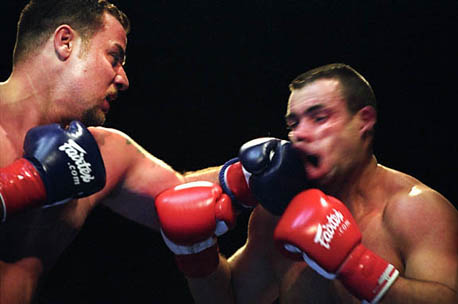
Western Boxing is the opposite of WTF Taekwon-Do as it focus on hand strikes only. Some boxers even learn how to (illegally) use elbow-strikes in their sparring. Unfortunately, boxing does not prepare one for low attacks, such as kicks to the legs or take downs.

ITF Taekwon-Do' tournament sparring is a little better as body armour and head guards are not worn and both hand and foot techniques are encouraged; however, some of the best self-defence techniques like elbow-strikes and low attacks are illegal. Because ITF practitioners use a lot of kicking they may not be used to sparring at close range, like boxers are, and since low attacks are illegal, they may not know how to defend against low attacks.

One would think that Muay Thai, which includes elbow-strikes, knee kicks, and low attacks, is better. Unfortunately, Muay Thai has its own bad habits it enforces. Muay Thai focus primarily on power attacks, which are slower, and sometimes even cause practitioners to turn their backs on their opponents. In Muay Thai many vital spots are also open. Of course, these practitioners are extremely conditioned, but such open vital spots are still bad in a self-defence situation where you can never be sure that your opponent does not have a weapon. Taking a kick to the ribs is one thing; a knife stab to the ribs is something completely different.

Taekkyeon tournaments are interesting because they allow both high and low attacks. The low attacks are much more varied and effective than the simple roundhouse kick to the thigh one sees in Muay Thai. Taekkyeon also allow sweeps and throws. The bad thing about Taekkyeon tournaments is that hard hand attacks like punches are not included.This might mean that Taekkyeon practitioners are not adapt at blocking certain types of attacks.

How about the grappling styles, like for instance Brazilian Jiu-Jitsu? BJJ is wonderful as it gets you accustomed to fighting on the ground. The problem of defending against different types of strikes while on the ground aside, BJJ's strategy to go to the ground could be a dangerous one in the streets. Their might be glass, rocks and other harmful objects on the ground. When you are on the ground fighting your opponent you are a very easy target for your opponent's buddies to start kicking you. It is true that your opponent's buddies could attack you while you are standing also, but in a standing position you are much more mobile. Street fighters know that more people die on the ground than when standing up. Granted, defending yourself against multiple attacks while standing is not easy, but it is easier than while you are on the floor.

BJJ and Mixed Martial Arts that often spar on the ground are not without their problematic rules either. In MMA fights, grappling often results in technical knock outs with such techniques as the rear naked choke, triangle choke and the like. Were you to change one or two simple rules to make these fights more “street accurate” most of these winning techniques will not work as effectively any more. Include, for instance, biting or attacking small joints. Once you are allowed to bite, or bend over fingers, there is suddenly a host of escapes from these grappling techniques. Furthermore, biting will make ground fighting a much more risky activity. Were people allowed to bite and attack small wrist, MMA fighters will suddenly spend much less time embracing each other, and instead try and keep their distance.

If we are competing in tournament sparring purely for its sport value, then I have no issue with tournament sparring. My issue is that people often confuse tournament sparring with self-defence training. Tournament sparring could have a peripheral value for self-defence training, but generally I think that an overemphasis on tournament sparring could actually hamper preparation for self-defence. And I am not alone: self-defence guru Marc "Animal" MacYoung has similar sentiments in his book A Professional's Guide to Ending Violence Quickly: How Bouncers, Bodyguards, and Other Security Professionals Handle Ugly Situations. Tournament rules create a confining box, which I believe could be negative for self-defence situations. Often the tournaments of specific styles only prepare one to defend against someone that fights like that style. If your tournament does not allow low kicks, you probably won't know how to defend against low kicks. If your tournament have no ground fighting you may not know how to defend against a grappler. If you are a grappler but have never been bitten before, because biting is illegal in your style, you may find yourself suddenly with a chunk of biceps-muscle bitten off as you attempted to do a rear naked choke!


Image Sources:
ITF Sparring -- Personal