A Blog on Martial Art Technique and Philosophy with Emphasis on (ITF) Taekwon-Do.
08 April 2025
Korea Deconstructed Interview
18 January 2022
The Tenet of ‘Courtesy’ in Taekwon-Do
| Calligraphy by Choi Hong-Hi of the Tenets of Taekwon-Do |
General Choi Hong-hi, the founder of ITF Taekwon-Do, composed a list of five tenets that he required practitioners to recite and embody. The tenets, as they are translated into English, are courtesy [예의], integrity [염치], perseverance [인내], self-control [극기], and an indomitable spirit [백절 불굴]. As I pointed out in a previous essay, with some of these terms, there is something lost in translation. This is also the case for the first tenet, “courtesy”.
In English, the word “courtesy” suggests polite and respectful behaviour with proper etiquette, which is close to the translations one would get if you search the equivalent Korean word [예의] in a Korean-English dictionary: manners, etiquette, courtesy, politeness, proprieties, decorum, and civility.
While this may be a general understanding of the term, the Korean word “ye-eui” has a deeper connotation which one may glimpse when you look at the hanja (Chinese characters) on which the word is based. The hanja for “ye-eui” [예의] is 禮儀. The first character [禮] can translate to manners (decent and respectable behaviour) or ritual propriety (proper actions during rites and ritual ceremonies), while the second character roughly translates to proper etiquette, but can also translate as righteous or lawful behaviour. What I want to point out here is that the Korean term “ye-eui” [예의] has a much more demanding implication than the English word “courtesy”. Courteous behaviour may simply be good manners and one’s adherence or disregard of them does not really have any serious consequences. Whereas the Korean term implies the righteousness or lawfulness of one’s conduct.
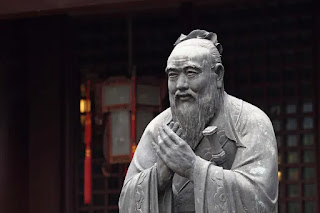
| Confucius was a Chinese sage-philosopher whose teachings greatly affected East Asia. There are still many aspects of Confucianism that are part of modern Korean culture. |
Confucianism is fundamental to Korean culture and central to Confucianism is the concept of li (‘ritual propriety’ or ‘sense-of-ritual’). Li covers a wide range of conduct and behaviour from religious rites to state and governmental rituals, to social ceremonies such as at weddings and funerals, to appropriate etiquette for social relations. In other words, it covers every aspect of one’s life: in religious matters, with regards to the State, in society at large, within families, and among all relationships. It is both the adherence to state laws and the respect one shows to one’s parents and elders, including the good manners when interacting with people in daily life, even such seeming trivialities as drinking etiquette and table manners.
Confucianism (cf. Mencius) believes that we have the seeds of li innately inside us, but that a ‘sense-of-ritual’ should be learned and developed. The idea of “ritual” here should be understood more broadly to include all appropriate behaviours: manners, etiquette, lawful deeds and righteous conduct. Furthermore, notice the concept “sense-of-ritual”: it is not merely about adhering to codes and rules of conduct; rather, there should be an internal sense of appropriate behaviour. Thus, “sense-of-ritual” refers to a developed moral sensibility.
The Confucian ideal is to be a junzi [君子], often translated as “a gentleman” or “superior person.” (The Korean equivalent is a gunja [군자], a person of virtue and culture.) When Confucius’ greatest disciple Yan Hui asked his Master about perfect virtue (ren 仁), Confucius answered: “Don’t look in a way that is not li, don’t listen in a way that is not li, don’t speak in a way that is not li, and don’t move in a way that is not li.” It would be incorrect to conclude that it is all about outward behaviours—how one ought to or ought not to behave. Confucius’ answer was in regard to his student’s question about virtue. Virtue is more than just an outward display; in a righteous person, virtues have become internalized. Confucian scholars like Mencius considered li a virtue alongside other virtues such as benevolence, filial piety, and sincerity. To another student Confucius answered: “Let your words be sincere and truthful and your actions honorable and careful.”
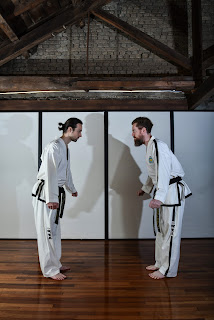
| Bowing before training is one part of showing courtesy. |
To bring it back to our original discussion of Taekwon-Do’s tenet of courtesy, the Chinese term li is in fact the same first character in the word “ye-eui” [예의, 禮儀]. Often in Taekwon-Do we understand “courtesy” simply as the respectful behaviours in the dojang such as taking our shoes off before stepping onto the mat, or bowing to instructors or to our opponents before sparring; however, as I tried to show here, ‘courtesy’ must be understood in a much broader sense. Like the other tenets, it is not just limited to the confines of the dojang. The courtesy tenet extends to how we treat people in our daily lives—with respect and sincerity—and the way we conduct ourselves in society. It is not merely about behaviour, but rather an attitude (“sense-of-ritual”). It is also culturally sensitive and situationally sensitive, what Koreans call nunchi [눈치], which is the ability to read a social situation and act appropriately. To embody courtesy means that you will conduct yourself in a noble and virtuous manner at all times—like a junzi / gunja, a person of culture and learning.
06 June 2019
The Unfortunate Cost of Evolving from Martial Art to Combat Sport
However, in this post I want to speak about other "costs" that comes at the expense of a sport focus.
Here I want to focus on the WT style of Taekwon-Do as an Olympic sport. There are some attempts to get ITF Taekwon-Do to also join with WT to become one event alongside WT under the "Taekwondo" umbrella. There is a believe that such a move will secure the ITF Taekwon-Do's longevity, enhance its prestige, and strengthen Taekwon-Do's position at the Olympic Games.
![]() |
| Image Source: https://www.olympic.org/taekwondo |
I am somewhat skeptical. I believe an evolution from martial art to combat sport comes at an unfortunate cost.
First, when a martial art changes into a sport there is a dilution of the rich historical arsenal of the original system. When Judo was developed as a streamlined version of Jujutsu, many of the original techniques were purged. Similarly, when the focus in Taekwondo becomes sport competition, a big percentage of techniques are inevitably neglected. Taekwondo enthusiasts are all aware how Olympic Taekwondo has reduced the martial art—that is by its very name supposed to be a foot-and-hand system—into primarily a kicking system. Sadly, an emphasis on kicking in sport Taekwondo has not enriched Taekwondo’s kicking arsenal with more kicks, but rather reduced the arsenal to only a handful of techniques that works well in the limited context of the sports ring.
![]() |
| Image Source: https://en.wikipedia.org/wiki/Greco-Roman_wrestling |
Third, when the philosophical and cultural heritage is removed it is often replaced with “[p]ositive sporting values and objectives”*. In the case of Taekwondo as promoted by the WT, an emphasis is given to the sport values of Olympism. This means that the original East Asian philosophy and values that are inherent to the martial arts are replaced with western values (i.e. Grecian inspired Olympism) for the combat sport. The adoption of Olympism may at first seem commendable. However, the East Asian martial arts are not culturally neutral. Quite the opposite: East Asian martial arts, like folk dances, function as containers of cultural heritage. Therefore, when focussing on the sport aspect of the martial art there is an emphasis of the new sport values, which inevitably results in a de-emphasis of the original cultural heritage. In a discussion on the western-centric Olympic sports, Allen Guttmann laments the resultant cultural imperialism. He argues that even when East Asian martial arts spread to the west, they often “[transformed] in accordance with Western assumptions about the nature of sports”*. Ironically, instead of the intended goal of using Taekwondo for soft power diplomacy the result is a form of “soft colonialism,” where the original martial art loses its Oriental identity—to be replaced with a western inspired identity. At the very least this should be considered culturally insensitive and a regrettable loss.
Is the security and prestige of joining the Olympic Games worth the losses? For some people who see the opportunity of winning a medal at the Olympic Games in their chosen sport, it is worth it. For others, those who see the martial arts something other than a sport, for example as containers of cultural heritage, it is not.
29 March 2011
"Walk on the Right Side"
| Image Source |
The traffic system in South Korea was based on the United States and dates from the 1960s and 70s when President Park Chung-Hee pushed for economic reform that included great infrastructural development. South Korea's roads and traffic laws were modelled after that of the United States. While Korea's traffic system dates from this era, Korea's pedestrian habit of walking on the left side has an earlier source – the Japanese occupation.
![]() |
| A photo of a samurai carrying his swords on his left side. |
The reason I'm recounting Korea's (and Japan's) walking habits is to show how the way we move is often influenced by the culture and socio-political environments we find ourselves in. It is undeniable that the techniques we learn in whichever martial art we study were forged from within a specific culture, with its historic influences, and a certain socio-political context. And sometimes such techniques become outdated. South Korea decided recently to change the pedestrian habit which is not in sync with the more recently developed traffic laws. Similarly, some techniques in our martial art may be outdated or be culturally irrelevant. There are a number of examples, but I will focus on only one, because it so vividly illustrates my point.
| A throwing technique from a kneeling position. |
It is important for any instructor to research his system's techniques and question their current validity. If they are not of value within your cultural and socio-political contexts, then maybe you should not spend too much time on them. In a previous post titled “I Don't Like Your Self-Defence” I discussed this issue in more detail. Not spending as much time on the techniques that are culturally or socio-politically of less value is one thing, another important point is to actively increase the training of those techniques that are fitting the likely scenarios your students may find themselves in. This may very well require you to reinterpret the techniques in your system and make them practical and sensible for your cultural and socio-political context.
![]() |
| Korean marines training during the Vietnam War. Image Source |


