
In my previous post I voiced my disagreement with the overemphasis of tournament sparring. One of my arguments was that tournament sparring creates a mindset that is contrary to the mindset one needs for a self-defence situation. As I mentioned in the previous post, tournament rules condition you to think of a physical encounter as something that happens between exactly two individuals, using a particular set of attacks, aimed at a few specific targets, for instance the head, chest and obliques. Not only does this condition you to ignore other highly effective techniques like biting, you are also less likely to consider other very vulnerable targets like the knees. In this post I'd like us to contemplate the effect of tournament rules on one's fighting paradigm.

In WTF Taekwon-Do tournament sparring, the competitors wear body armour and a head guard. Hand attacks to the head are illegal. Because of these safety rules, practitioners are not very concerned about blocking. They rely on distancing, the body armour and the rules to keep them safe from punches to the head. Now, in an actual fight, the ability to use your hands for protection is essential. Unfortunately, WTF practitioners tend to fight with their hands down; a very bad habit if one were to fight outside of the ring.
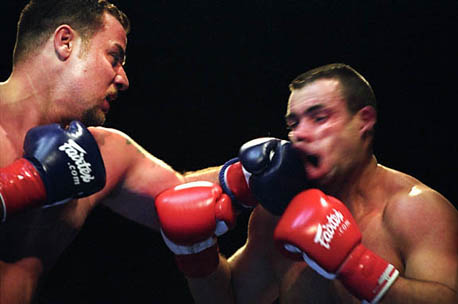
Western Boxing is the opposite of WTF Taekwon-Do as it focus on hand strikes only. Some boxers even learn how to (illegally) use elbow-strikes in their sparring. Unfortunately, boxing does not prepare one for low attacks, such as kicks to the legs or take downs.

ITF Taekwon-Do' tournament sparring is a little better as body armour and head guards are not worn and both hand and foot techniques are encouraged; however, some of the best self-defence techniques like elbow-strikes and low attacks are illegal. Because ITF practitioners use a lot of kicking they may not be used to sparring at close range, like boxers are, and since low attacks are illegal, they may not know how to defend against low attacks.

One would think that Muay Thai, which includes elbow-strikes, knee kicks, and low attacks, is better. Unfortunately, Muay Thai has its own bad habits it enforces. Muay Thai focus primarily on power attacks, which are slower, and sometimes even cause practitioners to turn their backs on their opponents. In Muay Thai many vital spots are also open. Of course, these practitioners are extremely conditioned, but such open vital spots are still bad in a self-defence situation where you can never be sure that your opponent does not have a weapon. Taking a kick to the ribs is one thing; a knife stab to the ribs is something completely different.

Taekkyeon tournaments are interesting because they allow both high and low attacks. The low attacks are much more varied and effective than the simple roundhouse kick to the thigh one sees in Muay Thai. Taekkyeon also allow sweeps and throws. The bad thing about Taekkyeon tournaments is that hard hand attacks like punches are not included.This might mean that Taekkyeon practitioners are not adapt at blocking certain types of attacks.

How about the grappling styles, like for instance Brazilian Jiu-Jitsu? BJJ is wonderful as it gets you accustomed to fighting on the ground. The problem of defending against different types of strikes while on the ground aside, BJJ's strategy to go to the ground could be a dangerous one in the streets. Their might be glass, rocks and other harmful objects on the ground. When you are on the ground fighting your opponent you are a very easy target for your opponent's buddies to start kicking you. It is true that your opponent's buddies could attack you while you are standing also, but in a standing position you are much more mobile. Street fighters know that more people die on the ground than when standing up. Granted, defending yourself against multiple attacks while standing is not easy, but it is easier than while you are on the floor.

BJJ and Mixed Martial Arts that often spar on the ground are not without their problematic rules either. In MMA fights, grappling often results in technical knock outs with such techniques as the rear naked choke, triangle choke and the like. Were you to change one or two simple rules to make these fights more “street accurate” most of these winning techniques will not work as effectively any more. Include, for instance, biting or attacking small joints. Once you are allowed to bite, or bend over fingers, there is suddenly a host of escapes from these grappling techniques. Furthermore, biting will make ground fighting a much more risky activity. Were people allowed to bite and attack small wrist, MMA fighters will suddenly spend much less time embracing each other, and instead try and keep their distance.
If we are competing in tournament sparring purely for its sport value, then I have no issue with tournament sparring. My issue is that people often confuse tournament sparring with self-defence training. Tournament sparring could have a peripheral value for self-defence training, but generally I think that an overemphasis on tournament sparring could actually hamper preparation for self-defence. And I am not alone: self-defence guru Marc "Animal" MacYoung has similar sentiments in his book A Professional's Guide to Ending Violence Quickly: How Bouncers, Bodyguards, and Other Security Professionals Handle Ugly Situations. Tournament rules create a confining box, which I believe could be negative for self-defence situations. Often the tournaments of specific styles only prepare one to defend against someone that fights like that style. If your tournament does not allow low kicks, you probably won't know how to defend against low kicks. If your tournament have no ground fighting you may not know how to defend against a grappler. If you are a grappler but have never been bitten before, because biting is illegal in your style, you may find yourself suddenly with a chunk of biceps-muscle bitten off as you attempted to do a rear naked choke!
Image Sources:
ITF Sparring -- Personal


