Showing posts with label moral culture. Show all posts

17 November 2024

Taekwon-Do and Social Justice

While searching through one of my folders, I came upon an essay I wrote for Totally Tae Kwon Do Magazine (Issue #138 - August 2020). Usually the essays and articles I write for Totally TKD develop out of drafts that I publish here on this blog, but I noticed that this particular essay didn't evolve from the blog, but was rather a reworking of an academic presentation that I delivered in 2019. So I thought it would be good to share the essay here as well. The essay below is a somewhat amended version of the original one published in 2020. 

 I also recommend anyone who is a Taekwon-Do geek, like myself, to subscribe to Totally Tae Kwon Do Magazine -- it is the only monthly (electronic) magazine dedicated to sharing news, opinions, interviews, and essays on Taekwon-Do. 

...ooOoo...

Taekwon-Do and Social Justice

By Dr Sanko Lewis

A year ago, I presented a paper in South Korea, at Youngsan University’s 1st International Academic Taekwondo Conference. I titled my presentation “From Individual Heroes to National Performers: The Shift in Taekwondo’s Peace Promotion Duty.” Since then the paper has been accepted for publication in the Physical Activity Review Vol. 8(2), 2020*, with Dr. John Johnson as co-author. In the article we point out that the early Taekwon-Do pioneers saw Taekwon-Do practitioners as heroes of justice.


In his 1957 Korean Karate textbook Pasa Gwanbeop, Park Chul-hee’s envisioned martial arts training as a way to:

·       build an indomitable spirit

·       and a sound character

·       so that one would dash at the cause of justice,

·       and make a contribution to world peace.


In 1965, Choi Hong-hi wrote in the first book using the term “Taekwon-Do” that Taekwon-Do should be:

·       a weapon for self-defence,

·       to defend justice,

·       to defend the weak.

Lee Won-kuk’s Taekwondo Manual from 1968 states that Taekwon-Do trainees should:

·       love peace,

·       protect justice and humanitarianism,

·       and not initiate fights.


Choi Hong-hi’s 1975 book Taekwon-Do: The Korean Art of Self-Defense admonishes practitioners to:

·       be gentle to the weak and tough to the strong,

·       be champions of freedom and justice,

·       and build a more peaceful world.


Based on these writings, we can deduce how the early pioneers envisioned the ideal Taekwon-Do practitioner: an individual with a morally sound character, noted for their courage and indomitable spirit, who toughen their bodies and perfect their techniques to be able to defend themselves and the weak from abuse, and promote justice and (world) peace.


For many modern practitioners, Taekwon-Do is just a sport, so Taekwon-Do athletes may not feel that their participation in Taekwon-Do necessitate that they take a particular moral stance or actively step up to protect the weak or stand up for justice, any more than say a soccer player does. However, those that partake in Taekwon-Do as a martial art—a “Way”—, rather than just a combat sport, are implicitly agreeing to use their ability to protect the weak against the strong. In fact, some martial art philosophers such as Daeshik Kim and Allan Bäck, for instance, argue that everyone—who wants to be a good person—has a moral duty to become proficient in self-defense for the sake of self-preservation and to protect others from harm.


Coming up for someone that is being bullied or rushing to the aid of a victim of violence ought to be the default behavior of a Mudo-in 무도인 (“martial-Way-person”). Doing so, of course, is highly likely to have the violence previously directed at the victim now directed at your own person. That is why one ought not have false confidence. Hence, the Taekwon-Do pioneers urged practitioners to have their courage founded upon the sincerity of hard practice. To oppose violence, one needs to have a toughened body and proper combative skill combined with courage.


However, the “clear” responsibility to defend the weak against violence is not the only responsibility the early pioneers promoted. They also declared a duty towards upholding and defending justice. It is easy to see the injustice of a stronger person bullying a weaker person, but other injustices are often less obvious. What type of justice(s) should Taekwon-Do practitioners fight for? Is it only regulated to the injustice of bullying and physical violence, or does it include other human rights violations? If you believe that there are systems in place that mistreat or oppress certain people in society then we, as martial artists, should support such movements. Systems and policies that somehow subjugate people—that treat one group of society differently, oppressively—are akin to the abuse by bullies of their victims. If we oppose the abusive behavior of bullies, then we ought to oppose the abusive behavior of bullying systems. But it is all to easy to become swept up by a movement without having thought it through and researched for clear evidence.


The question of “justice” is unfortunately not always clear, and some social justice topics can be quite polarizing. Consider some of the following justice/rights issues; while reading through the list notice the emotional reflexes and immediate opinions that arise within you:

  • Climate Justice (How climate change disproportionately impact marginalized communities.)
  • Healthcare Access
  • Racial Justice
  • LGBTQIA+ Rights
  • Economic Inequality
  • Refugee Crises (The plight of refugees and displaced peoples due to conflict, persecution, or environmental disasters, but also the issue of illegal immigration)
  • Gender (In)equality
  • Gun Violence
  • Agism 
  • Body Autonomy
  • Indigenous Rights
  • Disability Rights
  • DEI (Diversity, Equity, Inclusion)
  • Geopolitical conflicts (e.g., Russia-Ukraine, Israel-Palestine, China-Taiwan, etc.)


I may have strong opinions on specific contentious issues and possibly you have equal but opposing views. How active should Taekwon-Do practitioners be involved in such matters? Some of these issues may be cultural and situational, making it difficult for a lay person—i.e., someone who is not an ethicist—to decipher. And even when a martial arts instructor has a particular opinion, they might not be inclined to support it openly for fear of losing students. (This is where the tenet of integrity comes in.)


If we decide to take the moral teachings of Taekwon-Do seriously, we as Taekwon-Do practitioners ought not ignore the suffering of the weak and oppressed. Based on the writings of the early pioneers, Taekwon-Do practitioners should oppose oppression (injustices) and defend (support) the weak. Practitioners who takes Taekwon-Do's moral teachings seriously cannot ignore the injustices around them. Yet, I would caution against jumping on the bandwagon just because a particular cause is popular at that moment. It is best to make informed decisions rather that rash, emotional ones. Read widely, get informed about important issues, and try talking to people outside of your “bubble.” We are living in a #PostTruth world in which misinformation and disinformation abound, which makes it ever more important to avoid rashness, lest in our emotional foolhardiness we find ourselves fighting on the wrong side. It is not for naught that the Daoist's teach caution over false heroic brashness. 


In choosing social injustices to oppose, consider the adage: “choose your battles wisely”. Part of what this means is to choose the battles within your sphere of influence. There are too many injustices in this world for you to fight against. Trying to oppose them all will spread you out too thin and burn you out emotionally, making your contribution ineffective. Choose the battles that present themselves before you, the ones at hand, the ones in your own community where you can make an actual contribution. As the proverb says, “charity begins at home.” It is useless virtue signaling to make TikTok-videos about some abstract social justice issue, but ignore the homeless person on the street corner who has nowhere to sleep because your local city council put spikes under bridges and partitions on park benches. 


Likewise, I would also caution against becoming a “keyboard warrior”—i.e., someone who “fights” on social media. While cyber space has indeed become an extension of our normal (off-line) lives, we should be careful not to fall into the trap of thinking that our online activism is more important or a substitute for ‘real world’ contributions.


Of course, in our effort to help build a more peaceful world, we ought not initiate fights and try to avoid violence; at the same time, the pioneers told us to bravely dash towards the cause of justice and to protect it, and to defend the weak, regardless of their “religion, race, national or ideological boundaries,” against both physical harm and injustice. On this note, I think we should learn from the experience of being part of a global family through Taekwon-Do. I have been blessed with opportunities to visit different countries where I have trained and conducted seminars: I have also met many visitors to Korea—where I live—from around the world, and have gained friends from very diverse ethnicities, cultures, and religious backgrounds. Through our shared love of Taekwon-Do we were able to transcend our superficial differences to form lasting and valuable friendships. Before painting people who are different to you as the “other,” let this lesson from Taekwon-Do remind us of our common humanity.


There is also another object lesson to be learned from martial arts practice: it is when I face my opponent that my training becomes actualized; my opponent is therefore not an enemy, but an opportunity for growth. If possible, try not to see those people you consider your ‘enemies’ in society as such—let them not be ‘The Enemy,’ but rather view them as training partners in this journey we call life. And after the fight is done, let us hug, and shake hands, and bow to each other.


…ooOoo…

* http://www.physactiv.eu/wp-content/uploads/2020/07/2020_82_9.pdf

18 January 2022

The Tenet of ‘Courtesy’ in Taekwon-Do


Calligraphy by Choi Hong-Hi
of the Tenets of Taekwon-Do


General Choi Hong-hi, the founder of ITF Taekwon-Do, composed a list of five tenets that he required practitioners to recite and embody. The tenets, as they are translated into English, are courtesy [예의], integrity [염치], perseverance [인내], self-control [극기], and an indomitable spirit [백절 불굴]. As I pointed out in a previous essay, with some of these terms, there is something lost in translation. This is also the case for the first tenet, “courtesy”.


In English, the word “courtesy” suggests polite and respectful behaviour with proper etiquette, which is close to the translations one would get if you search the equivalent Korean word [예의] in a Korean-English dictionary: manners, etiquette, courtesy, politeness, proprieties, decorum, and civility.


While this may be a general understanding of the term, the Korean word “ye-eui” has a deeper connotation which one may glimpse when you look at the hanja (Chinese characters) on which the word is based. The hanja for “ye-eui” [예의] is 禮儀. The first character [禮] can translate to manners (decent and respectable behaviour) or ritual propriety (proper actions during rites and ritual ceremonies), while the second character roughly translates to proper etiquette, but can also translate as righteous or lawful behaviour. What I want to point out here is that the Korean term “ye-eui” [예의] has a much more demanding implication than the English word “courtesy”. Courteous behaviour may simply be good manners and one’s adherence or disregard of them does not really have any serious consequences. Whereas the Korean term implies the righteousness or lawfulness of one’s conduct. 


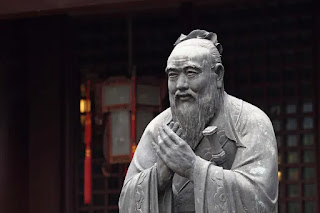
Confucius was a Chinese sage-philosopher
whose teachings greatly affected East Asia.
There are still many aspects of Confucianism
that are part of modern Korean culture.


Confucianism is fundamental to Korean culture and central to Confucianism is the concept of li (‘ritual propriety’ or ‘sense-of-ritual’). Li covers a wide range of conduct and behaviour from religious rites to state and governmental rituals, to social ceremonies such as at weddings and funerals, to appropriate etiquette for social relations. In other words, it covers every aspect of one’s life: in religious matters, with regards to the State, in society at large, within families, and among all relationships. It is both the adherence to state laws and the respect one shows to one’s parents and elders, including the good manners when interacting with people in daily life, even such seeming trivialities as drinking etiquette and table manners.

Confucianism (cf. Mencius) believes that we have the seeds of li innately inside us, but that a ‘sense-of-ritual’ should be learned and developed. The idea of “ritual” here should be understood more broadly to include all appropriate behaviours: manners, etiquette, lawful deeds and righteous conduct. Furthermore, notice the concept “sense-of-ritual”: it is not merely about adhering to codes and rules of conduct; rather, there should be an internal sense of appropriate behaviour. Thus, “sense-of-ritual” refers to a developed moral sensibility.

The Confucian ideal is to be a junzi [君子], often translated as “a gentleman” or “superior person.” (The Korean equivalent is a gunja [군자], a person of virtue and culture.) When Confucius’ greatest disciple Yan Hui asked his Master about perfect virtue (ren 仁), Confucius answered: “Don’t look in a way that is not li, don’t listen in a way that is not li, don’t speak in a way that is not li, and don’t move in a way that is not li.” It would be incorrect to conclude that it is all about outward behaviours—how one ought to or ought not to behave. Confucius’ answer was in regard to his student’s question about virtue. Virtue is more than just an outward display; in a righteous person, virtues have become internalized. Confucian scholars like Mencius considered li a virtue alongside other virtues such as benevolence, filial piety, and sincerity. To another student Confucius answered: “Let your words be sincere and truthful and your actions honorable and careful.”  


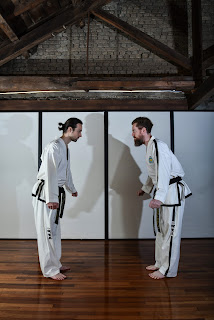
Bowing before training is one
part of showing courtesy.
 

To bring it back to our original discussion of Taekwon-Do’s tenet of courtesy, the Chinese term li is in fact the same first character in the word “ye-eui” [예의, 禮儀]. Often in Taekwon-Do we understand “courtesy” simply as the respectful behaviours in the dojang such as taking our shoes off before stepping onto the mat, or bowing to instructors or to our opponents before sparring; however, as I tried to show here, ‘courtesy’ must be understood in a much broader sense. Like the other tenets, it is not just limited to the confines of the dojang. The courtesy tenet extends to how we treat people in our daily lives—with respect and sincerity—and the way we conduct ourselves in society. It is not merely about behaviour, but rather an attitude (“sense-of-ritual”). It is also culturally sensitive and situationally sensitive, what Koreans call nunchi [눈치], which is the ability to read a social situation and act appropriately. To embody courtesy means that you will conduct yourself in a noble and virtuous manner at all times—like a junzi / gunja, a person of culture and learning.


04 September 2011

General Dojang Etiquette

I thought it good to review some of the common Taekwon-Do etiquette that are generally expected of students. Much of the text below I've gathered from a variety of ITF syllabi through the years. I can unfortunately not remember the original sources. Nonetheless, these “rules” are fairly common around the world and are generally applicable in all ITF Taekwon-Do schools.

In the Dojang

  • Don't be late for class. To be late shows disrespect for your fellow students, your instructor and the art. Instructors often plan a class with the students in mind that are likely to be in class, so if you are going to be late, inform the instructor. It is just good manners.
  • Upon entering and leaving the dojang bow to the class. Also make sure to bow to the instructor and all black belt members as a sign of greeting and respect. Bow and acknowledge others present in the dojang which should include firstly the instructor, the assistant instructor, then senior members. Children will acknowledge adults. Similar courtesies should be paid when visiting other martial arts dojang.
  • Where several people are entering, ensure the senior person or adult is shown the courtesy of entering first.
  • Remove footwear prior to stepping onto the training area. Ensure shoes or other articles are neatly stored in accordance with the wishes of the instructor.
  • While a class is in session, do not hang around or play around in the dojang. If you talk, let it be Taekwon-Do.
  • If you are early which is preferable, start warming up or practice your patterns.
  • Members should arrive at least 10 minutes before the commencement of class and be prepared both physically and mentally.
  • If the instructor is occupied, the most senior member present will commence training promptly until the instructor arrives.
  • If you are late change into dobok as quickly as possible, quickly loosen up and then stand on attention and wait for the instructor to invite you to join the rest of the class. Make sure to do your changing and loosening up as quickly as possible so that nobody needs to wait for you. It is considered very rude and disrespectful to have the class have to wait for you. When late, stand at the back or side of the dojang in such a manner that you are clearly visible to the instructor, but not disturbing, until the instructor acknowledge and invite you onto the training area.
  • Never be disrespectful to your instructor during class. If you disagree with the use of a technique, discuss it after the class in private. Never speak to your instructor on first name basis while you are in dobok. Use the appropriate titles.
  • All members must treat each other with courtesy.
  • When seeking to meet or ask a question of the instructor or senior, a student should stand at attention and keep alert to the situation at hand until approached or spoken to by the instructor or senior. The student shall ensure the dobok is well adjusted prior to the meeting.
  • Visiting instructors or seniors should be acknowledged by all members present upon meeting and entering the dojang.
  • During training members should not leave the dojang without the permission of the instructor.
  • The junior students present shall be responsible for the setting up and tidying up of equipment and the dojang floor at each training session. The senior members (other than the instructor or his/her assistant) shall supervise the putting away of equipment by junior members after the completion of training having regards to the wishes of the instructor.
  • Members must ensure their dojang is kept tidy.
  • Members should ensure visitors are treated with courtesy, provided with seating, accompanied and given advice where necessary.
  • Members must not make any unnecessary noise or disturbance inside the dojang.
  • All training fees or payments must be paid promptly at times indicated by the instructor. (During the first week of each month.)
Dress
  • The correct uniform is a correct dobok top with a correct dobok trousers. Black belts shall where official black belts and have a 3cm wide trimming around the bottom of the jacket; 4th Dan’s and above are distinguished by a 3cm black stripes down the outside of the jacket sleeves and trousers.
  • Do not wear jewellery as it can cause injury to yourself and other students.
  • Dobok must always be clean, ironed and worn correctly. They should be in good repair. Female students may where a white (or corresponding belt colour) T-shirt or sport-bra under their dobok jacket. Ensure that your dobok is clean and neat at all times and your belt tied correctly - this shows your pride in the art.
  • Wash your dobok regularly. A dirty or smelly dobok shows disrespect to the style and your training partners.
  • Belts shall be worn by those qualified for them, wrapped around the waist once and tied in the correct manner.
  • During training, if the dobok needs to be tidied up, the student must turn about to adjust. Don't fidget with your dobok while facing the instructor or seniors.
  • Dobok should not be worn outside the dojang unless on special occasions as specified by the instructor. The DO-bok is intended for the DO-jang.
  • In the hot summer months the club T-shirt instead of the dobok jacket can be worn with permission from the instructor.
If there is anything you think that is also typically common Taekwon-Do etiquette for the dojang that I have missed, please share it in the comments. 

10 November 2010

What's the Difference Between “Perseverance” and “Indomitable Spirit”?

Taekwon-Do has five tenets, virtues that we strive to develop and adhere to. The Taekwon-Do tenets are courtesy, integrity, perseverance, self-control and an indomitable spirit. I've always wondered why this list should include both perseverance and indomitable spirit, as these two virtues—at least the English terms—seem very similar. Both suggest not giving up when the going gets tough.

My ITF Taekwon-Do instructor in Korea and I spoke a little about these terms last night where upon he mentioned that the word 인내 translated into English as “perseverance” has a courteous connotative meaning and is not a synonym with indomitable spirit 백잘불굴. Wanting to find out more, I decided to look into these Korean terms.

Let's start with perseverance 인내. Instead of perseverance, better translations would be patience or long-suffering. These latter translations better communicate why 인내 has a courteous implication. I think that patience is a greater virtue, and also much more difficult to cultivate, than perseverance. One can persevere at being stubborn, arrogant, and a multitude other vices. However, long-suffering, i.e. to endure “mental or physical discomfort for a protracted period of time patiently or without complaint,” is the attribute of a saintly person.

Now for indomitable spirit 백잘불굴. The latter part of this word, 불굴, means indomitable, basically to have “an iron will.” Another possible translation is indefatigable, a word I haven't come across before today. It basically means not-to-fatigue, or tirelessness, and alludes to persistence and stamina. The adjective form 불굴의 can also be translated as dauntless; in other words, resolutely courageous or extremely persistent and untiring. One online Korean-English dictionary gives the following example sentence “He has overcome (extreme) difficulties with a(n) undaunted [dauntless] fighting spirit.” 그는 불굴의 투지로 역경을 극복했다. The whole term 백잘불굴 is correctly translated as indomitable spirit. It would not be off the mark to translate 백잘불굴 as fighting spirit.

In summary: Taekwon-Do has five tenets or virtues, of which two, perseverance and indomitable spirit, seem similar. Their similarity is however inaccurate because of imperfect translation from Korean into English. When we look at better translations, patience or long-suffering and fighting spirit, we see that these two terms are quite different in meaning.